Manual payment processes are slow and often make mistakes. They also waste working capital and hurt business relationships. But, using automation in your Enterprise Resource Planning (ERP) system can change everything completely.
We’ve worked with companies across the U.S. and seen how automation helps. It makes complex tasks easy and part of everyday work.
The results are quick and big. Businesses get real-time cash flow visibility. They cut down on manual errors a lot. And, they build stronger partnerships with suppliers.
This article will show you how to use these technologies well. We’ll share our experience in making automation work for you. Our aim is to help you manage working capital better and stay ahead of the competition.
Key Takeaways
Automation in ERP systems changes how companies handle supplier payments and working capital.
Streamlined processes mean fewer errors and better efficiency.
Seeing cash flow clearly helps with planning and making decisions.
A practical, hands-on approach is key for success in the U.S. market.
Early payment discounts are easier to get with integrated tools.
Understanding Supply Chain Financing and Its Importance
Supply chain financing changes how we handle payments. It turns them from a problem into a tool for working together. This approach helps both big companies and their suppliers. It’s a win-win situation.
This section explains what it is, how it works, and why technology is key.
Definition and Components of Supply Chain Financing
Supply chain financing (SCF) is about improving cash flow. It lets buyers pay suppliers later and suppliers get paid early by a third party. This helps without hurting the relationship.
Most SCF programs have three main parts.
Component
How It Works
Primary Benefit
Reverse Factoring
A financier pays the supplier’s approved invoice early at a discounted rate, while the buyer pays the full amount later.
Supplier gains liquidity; buyer extends payables.
Inventory Financing
Financing is provided against purchased inventory or raw materials held by the buyer or supplier.
Unlocks capital tied up in stock, funding growth.
Dynamic Discounting
The buyer offers to pay an invoice early in exchange for a sliding-scale discount set by the supplier.
Buyer earns a return; supplier accelerates cash.
We find that mixing these tools works best. A company might use reverse factoring for key suppliers and dynamic discounting for others. This tailored approach is crucial for working capital optimization.
Benefits for Businesses and Suppliers
SCF offers mutual benefits. It moves beyond just helping one side to build a stronger partnership.
For Buyers (Businesses):
Improved Liquidity: Extending payment terms frees up cash on the balance sheet.
Strengthened Supply Chain: Healthy suppliers are more reliable and can invest in quality and innovation.
Cost Savings: Early payment discounts improve net income.
For Suppliers:
Predictable Cash Flow: Early payment removes the uncertainty of waiting 60 or 90 days.
Lower Financing Costs: Capital based on the buyer’s credit rating is often cheaper than loans.
Enhanced Business Stability: Reliable cash flow supports operations, payroll, and new opportunities.
This model makes the financial supply chain more resilient to market shocks.
Role of Technology in Supply Chain Financing
While the ideas are strong, old ways of doing things hold them back. Technology, especially with ERP systems, makes SCF efficient and scalable.
ERP acts as the brain. It connects data from the buyer, financier, and supplier. This makes:
Real-Time Data Exchange: Invoice status and payment info are updated instantly, cutting down on errors.
Automated Approval Workflows: Rules-based engines auto-approve invoices, speeding up the process.
Enhanced Transparency: Everyone has a clear view of transactions, building trust and reducing disputes.
We use this integration to make things smooth. Suppliers can ask for early payment easily. Buyers manage their financing from their ERP. This isn’t just about speed; it’s about making smart decisions with financial data.
Technology turns supply chain financing into a key part of a company’s financial supply chain strategy.
The Importance of Early Payment Discounts
Early payment discounts are more than just a nice gesture. They are a smart way to improve cash flow. This approach benefits both sides in B2B deals, helping with working capital and overall health.
When done right, it also improves relationships with suppliers. It reveals hidden value in existing payment terms.
How Early Payment Discounts Work
The idea is simple. A buyer pays an invoice early and gets a discount. Terms like “2/10 net 30” mean a 2% discount for early payment, with the full amount due in 30 days if not paid early.
Managing these discounts used to be hard and prone to mistakes. Now, dynamic discounting software makes it easy. It lets buyers set flexible discount rates and suppliers choose which invoices to fund.
Key Benefits for Buyers and Suppliers
Both sides gain a lot, creating a better financial partnership.
For Buyers:
Direct Cost Savings: Discounts mean higher profits with little risk.
Enhanced Budget Predictability: Paying early on some invoices helps manage cash better.
Strengthened Supplier Relationships: Reliable early payments build trust and can lead to better deals.
For Suppliers:
Immediate Liquidity Access: Turning receivables into cash quickly, without debt.
Reduced Reliance on External Financing: Cheaper than loans, it keeps more profit.
Lower Days Sales Outstanding (DSO): Faster cash flow means a healthier balance sheet.
Best Practices for Implementing Early Payment Discounts
Success needs a clear plan and the right tools. Our clients show that clarity and technology are key.
Establish Clear and Fair Terms: Start with simple, understandable discount terms. Explain the benefits well to suppliers to encourage them.
Leverage Automation Technology: Manual tracking is not sustainable. Use a dynamic discounting software to automate everything, from invitations to reconciliations.
Integrate with Your ERP System: For real efficiency, the software must link with your ERP. This ensures accurate data and avoids errors.
Use Data to Optimize Strategy: Analyze payment history and supplier behavior. Tailor discount rates and campaigns to maximize savings.
Manage the Change: Help your AP team and suppliers through the transition. Training and support are essential for smooth adoption.
By following these steps, companies can turn early payment discounts into a strategic, scalable program. This strengthens the entire supply chain’s financial health.
Integrating Supply Chain Financing into ERP Systems
When you automate financial processes, adding supply chain financing to your ERP system is key. It makes managing cash flow and vendor relationships easier. This integration is a smart move for businesses looking to improve their working capital.
Steps for Effective Integration
Start by checking if your ERP can handle dynamic discounting and supplier portals well. Then, pick financing modules that fit your current software. It’s important to set up automated workflows for invoice approval and payment.
Training your procurement and finance teams is the last step. This ensures they can use the new system smoothly.
Common Challenges and Solutions
Many companies struggle with data silos between their ERP and banking systems. We fix this by creating custom APIs for easy data sharing.
Changing B2B payment terms can be tough. We suggest a gradual rollout with clear benefits to get everyone on board. System issues are solved through thorough testing before launch.
Future Trends in ERP and Supply Chain Financing
The future is exciting. Artificial intelligence will help make better discount decisions. Blockchain will add security and clarity to transactions.
Cloud-based ERP systems from SAP and Oracle will grow with your global supply chain. These updates will make B2B payments more efficient.
By keeping up with these trends, your business will be more resilient and financially efficient.
FAQ
What is the primary benefit of automating supply chain finance within an ERP system?
Automating supply chain finance in an ERP system makes your financial flow smooth and clear. It gets rid of manual work, cuts down on mistakes, and lets you see your cash flow in real-time. This helps you manage your working capital better by speeding up payments and getting discounts sooner.
How does supply chain financing actually strengthen our relationship with suppliers?
Supply chain financing turns the payment process into a partnership. It gives suppliers early payment options, helping them stay financially stable. This makes your supply chain stronger and can even get you better deals from suppliers.
What is dynamic discounting, and how is it different from traditional early payment discounts?
Dynamic discounting is different from old-fashioned discounts. It’s a flexible system that lets suppliers choose when they get paid early for a discount. This way, both buyers and suppliers get a better deal, moving away from fixed terms.
What are the first steps to integrating supply chain financing into our existing ERP?
First, check if your ERP can handle supply chain finance. Then, find the right modules or platforms that fit. Make sure to map data flows, set up rules, and train everyone for a smooth rollout.
What is a common challenge during integration, and how do you solve it?
Breaking down data silos is a big challenge. Invoices and payments are often scattered. We create integrated workflows that use the ERP as the central hub. This ensures data flows smoothly and eliminates manual work.
How can we ensure we are getting the best value from early payment discount programs?
Use data to optimize your discounts. Analyze your costs and set discounts that benefit both you and your suppliers. This way, you get the most out of your early payment programs.
What future trends in ERP will impact supply chain financing?
AI, blockchain, and cloud ERP are big trends. AI helps predict cash flow, blockchain secures transactions, and cloud ERP makes updates easy. These changes will make advanced supply chain finance tools more accessible and effective.
Planning a big exhibit hall presence can be tough. Your marketing team and sales team use different systems. This makes it hard to see the whole picture and miss chances.
We faced this problem ourselves. It slows down planning and makes it hard to know if you’re doing well. Data stuck in different places can’t help make smart choices.
Our case study shows a great solution. We added B2B trade show software into a main customer relationship platform. Now, every part of your engagement is in one place.
This makes things run smoothly. Teams work together from start to finish, and even after the event. This article explains how this works and the benefits it brings.
Key Takeaways
Tools for trade shows and customer data that don’t talk to each other cause problems and keep data separate.
Putting event modules into a central CRM platform makes everything work together.
This unified system makes the whole process easier, from planning to checking how well the event did.
Having all data in one place helps make better choices during events.
It’s easier to see how well you’re doing financially with integrated analytics.
This approach helps teams work better together and manage leads better.
Our case study shows clear, measurable benefits from this integration.
Understanding Event Management CRM
An event management CRM is like the brain of all business events. It’s special software that goes beyond simple spreadsheets and contact lists. It makes a single place where all event tasks, interactions, and data connect.
What is Event Management CRM?
An event management CRM is a central hub. It brings together all parts of planning and execution into one workflow. Your attendee info, marketing emails, budget sheets, and tasks work together smoothly.
This integration gives a clear view of each event’s life cycle. Planners can track progress, measure engagement, and make quick decisions. It replaces old planning chaos with efficient, data-driven methods.
Key Features of Event Management CRM
This system’s power comes from its integrated tools. Each feature cuts down on manual work and connects your event strategy. Below are the main parts of a modern platform.
Feature
Core Function
Direct Business Impact
Centralized Attendee Database
Acts as a single source of truth for all contact details, registration history, and interaction logs.
Eliminates data silos, ensures every team member has the same updated information, and builds comprehensive attendee profiles.
Automated Email Campaigns
Schedules and sends personalized communications for invitations, reminders, and follow-ups based on attendee behavior.
Saves countless hours, increases open and click-through rates, and delivers timely, relevant messaging at scale.
Integrated Budget Tracking
Monitors expenses, revenue, and overall financial health in real-time, directly linked to event projects.
Provides instant visibility into ROI, prevents cost overruns, and simplifies financial reporting and forecasting.
Task & Project Management
Assigns responsibilities, sets deadlines, and tracks completion status for every team member and vendor.
Improves accountability, ensures nothing falls through the cracks, and keeps complex projects on schedule.
Registration & Ticketing Tools
Provides branded, secure portals for attendee sign-up, payment processing, and badge creation.
Creates a professional first impression, reduces administrative burden, and captures clean data from the start.
Benefits for Businesses
Using a dedicated event management CRM brings big wins. First, it boosts team coordination. Everyone works from the same place, cutting down on mistakes. Marketing, sales, and operations work together smoothly.
Another key benefit is better data and insights. Info goes into a structured system, not scattered files. This gives reliable, useful data. You can see what drives engagement and revenue, guiding future plans.
Lastly, businesses can handle more complex events. Automation frees up time for strategy. Teams can manage bigger events, run complex agendas, and personalize experiences. This leads to growth through efficiency.
Integrating Trade Show Modules
Adding trade show modules to your CRM makes it more than just a database. It turns it into a live, ready-to-use command center. These tools are made for the fast-paced world of trade shows. They connect face-to-face meetings with digital plans.
Without these modules, your team is stuck with paper notes and business cards. But with them, every meeting and chat becomes useful data. This integration is key to getting the most from your event investment.
Advantages of Trade Show Integration
Adding these modules brings quick, clear benefits. First, they let you capture and qualify leads in real-time. Your team can rate prospects right away, based on your rules.
This means you can follow up with hot leads quickly, even before the event ends. Second, they give you a complete view of the customer journey. You see every interaction, from scanning badges to downloading papers.
Lastly, they make your team more agile after the show. With all data in the system, your sales team can start reaching out the next day. No more waiting a week for data entry.
How to Choose the Right Trade Show Modules
Finding the right tools means focusing on your workflow. Not all modules are the same. You need ones that fit your team’s tech skills and your current systems.
Start by looking for a strong lead capture app. This is your first line of defense. It should work without internet and sync up fast when you get back online.
Look for modules that deeply integrate with your main CRM. Avoid tools that just dump data into a separate place. You want one place for all your data.
Use the table below to compare key features during your evaluation:
Feature
Basic Module
Advanced Module
Enterprise-Grade Module
Offline Functionality
Limited
Full functionality
Full with auto-sync
CRM Integration Depth
One-way data push
Two-way sync
Bi-directional with field mapping
Real-Time Analytics
Basic lead count
Booth traffic & engagement
Predictive lead scoring
Custom Survey & Forms
Pre-set templates
Fully customizable
Conditional logic branching
Best Practices for Implementation
A successful rollout needs good preparation and process. A great tool is useless if your team doesn’t know how to use it. Follow these steps for a smooth transition.
First, train your team well before the event. Practice at the booth. Everyone should be comfortable with the lead capture app.
Second, standardize your data fields. Decide exactly which show floor info goes into which CRM field. This consistency is key for syncing offline and online data.
Here is a core checklist for implementation day:
Conduct a final connectivity test on the show floor.
Assign a team member to monitor the sync dashboard in real-time.
Schedule a daily 15-minute debrief to review captured leads and adjust strategy.
The most important practice is managing the offline to online CRM handoff. Make sure all devices sync data within an hour of the show ending. This turns notes into tasks overnight.
Finally, integrate the captured data into sales workflows. Hot leads should automatically show up as tasks for your sales reps. This closed-loop process turns event effort into real revenue.
Enhancing Attendee Experience
The success of an event is tied to the attendee journey. An integrated CRM system makes this journey smooth and data-rich. It goes from registration to follow-up.
Tools for Engagement and Networking
Platforms like Cvent or Bizzabo have mobile apps. They include agendas, live polls, and AI matchmaking. These tools help attendees meet peers and exhibitors.
They turn a trade show into a lively networking spot.
Leveraging Data for Personalization
Every interaction creates data. This includes registration, session scans, and booth visits. Your CRM uses this data to personalize content in real-time.
You can send session tips or offers that match their interests. This personal touch is crucial for tracking event ROI.
Post-Event Follow-Up Strategies
The event’s real work starts after it ends. Use CRM segments to group attendees by interest and engagement. Tools like HubSpot or Marketo help send automated, yet personalized, emails.
Target hot leads differently from others. This approach makes tracking event ROI more accurate. It shows which interactions led to pipeline and revenue growth.
By focusing on the attendee experience, you create a seamless loop. It captures data, enables personalization, and drives follow-up. This closed-loop process proves the value of every event investment.
FAQ
What exactly is an event management CRM, and how is it different from a regular CRM?
An event management CRM is a platform that goes beyond basic contact management. It has tools for planning, executing, and analyzing events. Unlike regular CRMs, it’s a single place for attendee lists, email campaigns, and tracking budgets.
It helps your teams work together smoothly. This means no more data lost between marketing, sales, and events.
What are the main benefits of integrating trade show modules into our CRM?
Integrating trade show modules makes data flow smoothly from events to your sales pipeline. It uses a lead capture app for real-time lead tracking. This means no lost leads and faster sales follow-up.
It boosts lead conversion rates and speeds up the sales cycle.
How does your platform handle the critical “offline to online CRM” data sync after an event?
Our platform syncs data automatically and reliably. It uses mobile apps, badge scanners, or tablets to collect data. This data is then synced in real-time or when internet is available.
This includes contact info, notes, and lead scores. It keeps all interactions in one place for follow-up.
Can you give examples of tools that enhance attendee experience within an event management CRM?
A> Absolutely. We offer tools like agenda builders and matchmaking. These are based on attendee interests and profiles.
There’s also in-app messaging and interactive floor maps. By leveraging data for personalization, you can send targeted messages. This makes the event more engaging and valuable.
Why is post-event follow-up so much more effective with an integrated system?
With all event data in one place, follow-up can be targeted and timely. You can send personalized campaigns based on interactions and lead scores.
This increases engagement. It also helps track event ROI accurately. This way, you can measure the return from your investment.
How do we choose the right B2B trade show software modules for our needs?
Choose modules that solve your biggest problems. Look for lead capture, session management, and exhibitor portals. Make sure they integrate well with your CRM.
Focus on flexibility for different event types. This ensures a unified data set.
What does event ROI tracking look like in your platform?
Our event ROI tracking goes beyond basic numbers. It tracks a lead from booth scans to closed deals. You can attribute revenue to specific events.
This gives clear insights to justify event spend. It helps optimize future event strategies.
Creating detailed technical proposals for business clients is a big challenge. The manual process takes up a lot of time. It’s also prone to errors and hard to grow with your company.
These issues slow down the sales cycle and can hurt your profits. Our new case study looks at a powerful solution. We use an AI-enhanced CRM platform to make these complex documents automatically.
This smart method tackles the main problems of speed, consistency, and growth. In the next parts, we’ll dive into the tech, its real-world use, and the results it brings.
Key Takeaways
Manual proposal drafting is slow and often contains errors.
AI-driven CRM systems can automatically assemble complex technical documents.
This automation solves critical scalability problems in B2B sales operations.
Firms see measurable gains in team efficiency and process speed.
Higher accuracy in proposals can lead to improved competitive win rates.
The technology integrates smoothly with existing customer and product data.
Our analysis shows a clear path to transforming your sales workflow.
The Rise of AI in Proposal Generation
The old way of making technical proposals was slow and full of mistakes. Now, AI proposal software is changing this. It’s not just about making things faster; it’s about getting better at sales.
As B2B RFPs get more common and complex, the need for better proposals grows. Manual methods can’t keep up. AI is stepping in, making this hard task easier and more valuable.
Understanding AI Generated Proposals
An AI proposal is more than just a template. It’s a smart document that knows about the client and the project. It uses past successes and CRM data to create a draft that fits perfectly.
AI is different from old templates. It learns and gets better with each use. This makes it smarter over time.
Aspect
Traditional Templated Proposal
AI-Generated Proposal
Data Source
Static boilerplate text and manual data entry.
Dynamic integration with CRM, project history, and client communication logs.
Personalization
Limited to manually inserted client name and company details.
Context-aware, referencing past projects, stated pain points, and industry-specific terminology.
Speed of Creation
Hours to days, depending on complexity and staff availability.
First draft generated in minutes, allowing more time for strategic review and refinement.
Consistency & Compliance
Prone to human error and version control issues.
Automatically applies brand guidelines, legal clauses, and technical standards from a central library.
Benefits of AI in B2B Environments
AI proposal software brings big wins to B2B sales. It makes the sales process more efficient. This means more deals and more revenue.
“Implementing AI for our technical proposals cut our sales cycle by nearly 30%. It allowed our engineers to focus on solution design rather than document formatting, which was a game-changer for client satisfaction.”
Key benefits include:
Accelerated Sales Cycles: Proposals move from request to client 80% faster, shortening time-to-revenue.
Dramatically Reduced Administrative Overhead: Sales and technical teams reclaim hours previously spent on manual assembly and formatting.
Enhanced Quality and Accuracy: Automated compliance checks and data pulls from verified sources minimize errors that could derail a deal.
Superior Personalization at Scale: The system can tailor hundreds of proposals without sacrificing the individual touch that wins high-value contracts.
Key Features of AI-Enhanced CRMs
AI-enhanced CRMs have special features. These features work with your customer data. They make your CRM more powerful.
The most impactful features include:
Natural Language Processing (NLP): The engine reads and interprets RFP documents, client emails, and past notes to understand requirements and extract key terms for inclusion.
Unified Data Integration Layer: This connects proposal modules with product databases, pricing engines, service histories, and compliance libraries to pull accurate, real-time information.
Smart Content Library & Assembly: The system intelligently selects the most relevant case studies, technical specifications, and boilerplate clauses based on the client’s industry and the proposal’s context.
Collaborative Workflow Tools: Built-in review, commenting, and approval chains ensure the human team can efficiently refine the AI-generated draft before submission.
These features turn the CRM into a powerful tool. AI in proposal generation helps teams work better and faster. They can present a stronger, more professional image to clients.
Streamlining the Proposal Process
Using AI to streamline the proposal process combines technology, data, and human skills. It turns a slow, error-prone process into a fast and reliable way to make money. This change makes theoretical benefits real, improving speed, accuracy, and team morale.
Integrating AI with Existing Systems
Seamless integration is key to a successful AI setup. The goal is to improve, not replace, your current tech. Modern AI tools connect with your business systems like CRM, ERP, and CPQ platforms.
They use secure APIs for real-time data exchange. Your AI gets the latest customer info from CRM, inventory and costs from ERP, and pricing from CPQ. This creates a single truth source. The system learns your rules, ensuring proposals follow them from the start.
We aim to make this integration invisible to users. Sales teams use a unified interface in tools like Salesforce or Microsoft Dynamics. No need to switch apps. This breaks down data silos and gives the AI the latest, most accurate info.
Automating Repetitive Tasks
AI’s biggest impact is automating time-consuming tasks. This frees your team to focus on strategy, client relationships, and solving complex problems. Here are key areas where automation boosts efficiency:
Data Pulling and Population: No more manual searches for client details, past orders, and contract terms. The AI fills proposal templates with verified data automatically.
Pricing and Discount Calculations: Instant and accurate pricing, discounts, and promotions are calculated based on set rules, reducing errors.
Compliance and Boilerplate Insertion: Legal clauses, terms, and regulatory statements are added based on client industry and location.
This leads to consistent, error-free documents. The table below shows the difference between manual and AI-automated workflows for automated B2B quoting:
Task
Manual Process
AI-Automated Process
Gather Client Data
15-30 minutes across CRM, emails, and spreadsheets
Instantaneous, automated sync from integrated systems
Build Price Quote
20+ minutes, high risk of miscalculation
Seconds, with 100% rule-based accuracy
Add Compliance Text
10 minutes of copying, pasting, and verifying version
Automatic insertion of the latest approved clauses
Initial Draft Completion
45-60 minutes
Under 5 minutes
Enhancing Team Collaboration
AI boosts human collaboration. It turns a proposal platform into a hub for sales, account managers, and legal or technical reviewers. Everyone works from the same document with clear version control.
Role-based access lets team members see and edit only what they need. Sales can work on commercial terms, while the system flags legal sections for review. Engineers can add technical specs from a database. All changes are tracked, and notifications keep the process moving.
The biggest win is moving from a linear, hand-off process to a parallel, collaborative one. Reviews happen concurrently, not sequentially.
This setup reduces last-minute scrambles and miscommunication. Teams can make changes faster, incorporating client feedback in real-time. This leads to a more cohesive team that presents a unified, expert front to clients, increasing the chances of winning.
Customizing Proposals for Target Clients
AI-enhanced CRM truly shines when it goes beyond generic templates. It creates proposals that are deeply personalized. In complex B2B sales, clients want a document that shows they understand the client’s unique business and technical needs. Our method uses smart CRM document generation to turn standard responses into compelling, client-specific stories.
This change from a reactive to a proactive proposal process is a big deal. It lets our sales and technical teams focus on strategy and building relationships. Meanwhile, the system handles the hard work of putting together and customizing proposals.
Utilizing Data for Personalization
Good personalization starts with data. Our AI works with your CRM to gather a lot of information about clients. This isn’t just about putting a company name in a header.
The system looks at past interactions, support tickets, contract terms, and detailed client information. It uses this to adjust the proposal’s tone, pick the right case studies, and highlight what has worked for similar clients before.
Key data points for personalization include:
Past project history and success metrics
Communication preferences and key stakeholder roles
Industry-specific challenges and terminology
Budgetary signals and previous purchasing behavior
This data-driven approach makes every proposal feel like it was made just for the client.
Tailoring Content to Technical Requirements
For technical proposals, generic content is a problem. Our CRM document generation platform is great at matching solution details to client needs. Often, these needs are outlined in a Request for Proposal (RFP).
The AI reads technical RFPs and client briefs to find what’s most important. It then fills in sections on solution architecture, timelines, and specifications with the right content from your knowledge base.
“The system doesn’t just fill in blanks. It constructs a logical technical narrative that aligns our capabilities point-by-point with their stated needs, which is incredibly persuasive during evaluation.”
This makes sure complex information is presented clearly and correctly. It directly addresses the client’s operational realities.
Ensuring Compliance and Accuracy
Speed and personalization can’t come at the cost of correctness. A single mistake in a technical proposal can hurt trust and stop a deal. Our platform has strict checks in the CRM document generation workflow.
Every AI-generated draft gets checked for accuracy. These checks make sure all pricing is up-to-date, technical data is current, and legal clauses are included.
The following table shows automated checks versus areas for human review:
Automated System Check
Human Reviewer Focus
Clause Library Version Control
Strategic Messaging & Tone
Pricing & Discount Rule Adherence
Complex Custom Logic & Exceptions
Mandatory Regulatory Text Inclusion
Relationship & Nuanced Client History
This mix of automated checks and human review ensures proposals are not only personalized and persuasive but also accurate and legally sound. It turns your proposal into a reliable, client-ready document.
By mastering customization, we turn proposals into powerful competitive assets. This level of tailored communication, backed by data and ensured for accuracy, shortens sales cycles and boosts win rates.
Measuring Success and Continuous Improvement
Using AI for proposals needs a clear way to check how well it’s doing. We look at numbers to guide our plans. This makes sure our tools give us a good return.
KPIs for AI-Generated Proposals
Set up specific goals to track how well we’re doing. Watch how fast we can make proposals and how often we win deals. Also, check if our content matches what clients want. These goals help us see if our AI tools are working well.
Gathering Feedback and Iterating
We listen to what our sales engineers and clients say. We use this feedback to make our proposals better. By updating our system often, we keep our content up-to-date and competitive.
Case Studies of Successful Implementations
Real examples show how AI helps. An industrial supplier using Salesforce made proposals 35% faster. A cybersecurity vendor using AI in its CRM won 20% more complex bids. These stories show the power of modern sales tools.
FAQ
What are the main challenges your AI-enhanced CRM solves in B2B proposal drafting?
Our AI CRM tackles big issues like spending too much time on proposals and making mistakes. It also helps when you need to make more proposals quickly. Our AI software uses your CRM data to make detailed drafts fast, helping your sales process move faster.
How quickly can we expect a return on investment (ROI) from implementing this AI-driven approach?
You’ll likely see a return on investment in the first quarter. The big win is how fast you can make proposals. This makes your sales process quicker and saves money on manual work, letting your team focus on clients.
Can your AI proposal tool integrate with our existing tech stack, like Salesforce, SAP, or Microsoft Dynamics?
Yes, it can. Our platform is designed to work with big systems like Salesforce and Microsoft Dynamics 365. This keeps your workflow smooth and your data in one place for automated quoting and document making.
How does the system personalize a complex technical proposal for a specific client?
Our AI engine uses deep data to understand the client’s needs. It looks at the company’s data, your CRM history, and the RFP details. Then, it customizes the proposal to fit the client’s unique situation and technology.
What safeguards are in place to ensure technical accuracy and compliance in auto-generated proposals?
We have built-in checks to ensure accuracy and compliance. The system uses approved content and checks every draft. Sales engineers and legal teams review it, making sure it’s right before it goes out.
What key performance indicators (KPIs) should we track to measure the success of this automation?
Focus on metrics like how fast you can make proposals and how often you win. Also, look at client feedback and how much time your team saves. Our platform helps you track these, showing how well the system is working.
Is the AI capable of creating proposals from scratch, or does it rely on templates?
It’s a mix of both. Our AI uses smart templates but also creates new content. It makes each proposal unique, fitting your brand and following rules, while still being fast and efficient.
How does this improve collaboration between sales, engineering, and legal teams?
Our AI CRM brings everyone together in one place. Sales gives the client context, AI and engineers work on the tech, and legal reviews and approves. This makes teamwork better, reducing confusion and speeding up approvals.
Today, businesses face more pressure than ever to cut their environmental impact. Investors, consumers, and regulators want clear, useful data on emissions. Getting this data right is key to making real changes.
For a long time, companies used scattered spreadsheets and manual data entry. This method leads to data silos that are slow, prone to mistakes, and not good enough for today’s ESG reports. You can’t manage what you can’t measure well.
Integrated technology offers a big leap forward. A Cloud-based Enterprise Resource Planning system is like a brain for your business. It gathers real-time data from all parts of your operations—like energy use, logistics, and supply chain activities—into one place.
Choosing this technology is more than just an IT upgrade. It’s a strategic move for tracking sustainability. It turns complex data into easy-to-understand insights, helping you cut your environmental impact.
Key Takeaways
Businesses face escalating pressure from multiple stakeholders to accurately measure and report their environmental impact.
Traditional, siloed methods of data collection are inefficient and insufficient for rigorous ESG compliance.
Cloud ERP systems integrate disparate operational data—from energy to logistics—into one centralized platform.
This integration creates an auditable and reliable source of truth for sustainability metrics.
Implementing Cloud ERP is a strategic business decision that enables credible tracking and informed reduction of emissions.
Understanding the Importance of ERP in Sustainability
Many organizations overlook a powerful tool in their tech stack for sustainability: their ERP system. This integrated software suite does more than manage finances and inventory. It acts as the central hub for environmental data, turning raw numbers into actionable insights for reducing your carbon footprint.
What is an ERP System?
An Enterprise Resource Planning (ERP) system is like the central nervous system of a company. It’s a unified platform that connects and automates core business processes. These include finance, supply chain, manufacturing, and human resources.
By breaking down data silos, an ERP creates a single source of truth. This integration is key for any serious sustainability initiative. You can’t manage what you don’t measure, and ERP provides the framework for precise measurement.
How ERP Systems Can Reduce Carbon Footprint
The unified data model of a modern ERP eliminates guesswork and manual spreadsheets. It allows for the precise tracking of key environmental metrics. You can monitor energy consumption, material waste, and transportation miles.
This capability makes a robust ERP a powerful ESG reporting software. It automates data collection and consolidation for frameworks like the GHG Protocol. Your environmental impact data is always current and audit-ready.
For example, the system can automatically associate energy bills with specific departments or products. This pinpoint accuracy helps identify the largest sources of emissions. You can then target those areas for immediate efficiency improvements.
The Role of Automation in Sustainability Efforts
Automation is the engine that drives sustainable efficiency within an ERP. Manual processes are slow and prone to error, often leading to excess resource use. Automated workflows ensure operations are lean and optimized by default.
Consider the purchase order process. An ERP can be configured to favor vendors with strong sustainability credentials or shorter shipping distances. It can automate production schedules to minimize machine idle time and energy waste. In logistics, it can optimize delivery routes to reduce fuel consumption.
These automated actions happen continuously, without manual intervention. They create a leaner, greener operation by design. The system enforces sustainable practices at every step, turning policy into practice.
This level of automation transforms your ERP from a record-keeping tool into a proactive ESG reporting software and management platform. It helps you not just report on sustainability, but actively improve it every day.
Key Features of Cloud ERP for Carbon Footprint Tracking
Cloud ERP platforms offer the tools needed for tracking corporate sustainability. They turn environmental goals into actions. This makes big goals real and achievable.
Three key features are essential. These are live data, open connectivity, and clear visuals. Together, they help organizations manage their carbon footprint.
Real-Time Data Monitoring and Reporting
Old ways of reporting sustainability data are slow. They use monthly or quarterly summaries. Cloud ERP changes this.
It gives a constant flow of data. This includes energy use, fuel consumption, and emissions. Immediate visibility is the key advantage. Managers can see issues right away.
This leads to quick action. For example, fixing an HVAC system issue fast. Real-time monitoring makes carbon management proactive, not just a review.
Integration with Existing Sustainability Tools
Most companies use different tools for various tasks. Cloud ERP brings all this data together.
It has open APIs for easy connections. This includes IoT sensors, BMS systems, and carbon accounting software. This integration eliminates dangerous data silos. It gives a complete view of your carbon footprint.
As one sustainability officer noted,
“True integration means our ERP talks to our solar panel monitors and our freight management system. That’s when the numbers start to tell the full story.”
User-Friendly Dashboards for Enhanced Visibility
Complex data is useless if it’s hard to understand. Cloud ERP platforms have visual dashboards.
These dashboards show data in easy-to-understand charts. Facility managers see building efficiency in real-time. Supply chain directors see transportation emissions on maps.
This enhanced visibility drives accountability and informed decision-making. Sustainability KPIs are shown alongside financial data. Executives can see progress easily during meetings.
The best dashboards are for specific roles. They give the right info to the right people. This helps everyone, from top to bottom, work towards sustainability goals. Clear visuals make managing carbon footprint easy.
Best Practices for Measuring Your Organization’s Carbon Footprint
To measure a company’s carbon footprint well, follow three key steps: set baselines, review regularly, and involve your team. A clear plan helps turn data into steps for improving the environment. Cloud ERP systems are key, making this process easier and part of your green IT plan.
Establishing Baselines and Key Performance Indicators (KPIs)
You can’t manage what you don’t measure. First, find out your exact emissions baseline. This is your starting point for all future efforts to reduce emissions.
A Cloud ERP system gathers data from energy bills, fuel use, and supply chain activities. It gives the detail needed to accurately calculate emissions. This data is crucial for credible reports.
After setting your baseline, define what success means. Key Performance Indicators (KPIs) turn broad goals into specific metrics. Good KPIs for managing carbon include:
Carbon intensity per unit of product manufactured
Energy efficiency per square foot of office space
Waste diversion rate from landfill
Percentage of renewable energy in total consumption
These KPIs should be set up in your ERP dashboards. This lets you track progress in real-time, making your green IT efforts measurable.
Regular Audits and Data Reviews
Data gets outdated over time. Regular audits keep your carbon accounting up to date and in line with changing standards. Aim for an annual or bi-annual review cycle.
Cloud ERP systems are great for this, keeping detailed audit trails. Every change is logged, making it easy for auditors to check. Automated reports can spot any big changes from your baseline for quick checks.
Here’s a good data review process:
Reconcile Source Data: Make sure all data from utilities, logistics, and procurement is correct in the ERP.
Validate Emission Factors: Keep your calculation methods up to date with the latest science.
Analyze Trends: Use ERP analytics to find high emission periods and figure out why.
This method keeps your carbon footprint accurate and your reports reliable.
Employee Engagement in Sustainability Initiatives
Technology gives you the numbers, but people make the change. Getting your team involved turns your green IT system into a tool for change.
ERP insights are great for sharing with your team. Show them how their actions affect the company’s carbon footprint. Visual dashboards make goals clear and achievable.
Make sustainability a team effort. Link individual actions to the company’s carbon goals. Consider rewarding teams that meet their efficiency targets.
When employees see how their actions affect the dashboard, sustainability becomes a shared goal.
This approach creates a cycle. Data from the ERP informs employees, who then change their behavior. This embeds environmental responsibility into your company’s operations.
Success Stories: Companies Leveraging ERP for Sustainability
Real-world examples show the power of Cloud ERP for environmental goals. These stories prove the concepts we’ve discussed deliver measurable results.
Case Study: A Major Manufacturer’s Approach
Schneider Electric uses its own EcoStruxure platform, a cloud-based ERP system. It unified data from factories worldwide. This provided a single source of truth for energy and resource use.
The system identified significant energy waste in production lines. Automated adjustments were made. This led to a double-digit percentage reduction in the company’s operational carbon footprint.
How a Retail Chain Improved Its Carbon Metrics
Walmart employs a sophisticated ERP to manage its vast supply chain. The system optimizes delivery routes and warehouse inventory levels in real-time.
This optimization reduced miles driven by its fleet. It also minimized spoilage for perishable goods. The initiative directly lowered the retailer’s Scope 3 emissions, a major part of its enterprise emissions tracking.
Lessons Learned from Early Adopters in Various Industries
Early adopters from manufacturing to retail share common insights. Strong executive sponsorship is non-negotiable for securing resources and driving change.
Starting with a focused pilot project builds confidence. It shows quick wins before a full-scale rollout. Choosing an ERP partner with dedicated sustainability modules is critical for accurate enterprise emissions tracking.
These companies demonstrate that environmental responsibility and operational efficiency are not competing goals. Strategic ERP deployment makes them achievable together.
FAQ
Why is a Cloud ERP system considered essential for accurate corporate carbon footprint tracking?
A Cloud ERP system is key because it brings all your data together. It covers everything from energy use to supply chain details. This means no more guessing or mistakes in spreadsheets. It gives you the exact data you need for ESG reports and tracking emissions.
How exactly can an ERP system help reduce our company’s carbon footprint?
An ERP system helps by making your operations more efficient. It automates things like scheduling and inventory, cutting down on waste and energy. It also helps you see where you can use less materials and travel fewer miles, leading to greener choices.
What specific features should we look for in Cloud ERP for sustainability?
Look for features that let you track data in real-time and connect with tools like IoT sensors. Also, find user-friendly dashboards. These features turn complex data into easy-to-use insights, helping you take action fast.
Can Cloud ERP integrate with our existing carbon accounting or energy management software?
Yes, Cloud ERP systems are designed to work with other tools. They have open APIs for easy integration with ESG reporting software, IoT devices, and energy systems. This creates a single place for all your sustainability data.
How does ERP support the establishment of a carbon emissions baseline and KPIs?
Your ERP system brings together data from different areas of your business. This is crucial for figuring out your emissions. Once you have this baseline, you can set and track KPIs like carbon intensity. This lets you see how you’re doing over time.
What role does automation in ERP play in our green IT strategy?
Automation is key to a green IT strategy. ERP automates tasks like procurement and logistics. This means better use of resources, less waste, and lower energy use. It makes sustainability part of your daily work.
Are there real-world examples of companies succeeding with ERP for sustainability?
Yes, many companies have seen big improvements. For example, a global manufacturer cut energy waste with SAP S/4HANA Cloud. A major retailer lowered fuel use and emissions with Oracle Cloud ERP. These stories show the benefits in both money and the environment.
How can ERP data help engage our employees in sustainability initiatives?
ERP data can make sustainability goals clear to everyone. It shows how teams can make a difference. This creates a sense of responsibility and shows how individual efforts help the company’s goals.
In the wholesale world, keeping clients engaged long-term is a big challenge. Transactional relationships often lack the depth needed for steady, ongoing business. Many companies struggle to move beyond just price negotiations and build real, strategic partnerships.
We found a powerful solution by blending loyalty initiatives with a strong customer relationship management system. This method goes beyond simple discounts. It creates a way to recognize and reward the true value of a wholesale partnership.
In this case study, we share our experience designing and implementing such a program. We talk about the specific hurdles we faced in the wholesale channel. We also share the tailored solutions we used with our CRM platform and the results we got. The outcome was a big improvement in long-term business alliances and a more stable revenue stream.
The fusion of strategy and technology transforms transactional relationships into strategic assets.
Understanding B2B Loyalty Programs
B2B loyalty programs are different from those for consumers. They focus on building strong partnerships for mutual growth. In the wholesale world, these programs do more than just offer rewards for transactions. They aim to help clients succeed in the long run by working together and understanding their needs.
It’s important to understand this. Good programs use data and strategy, not just good intentions. The right B2B loyalty program software is key to making this work.
What are B2B Loyalty Programs?
B2B loyalty programs reward wholesale clients for their business volume, how long they’ve been partners, or their strategic value. These programs are more complex than those for consumers, who often just buy and get rewards.
These programs recognize that client relationships are complex. Rewards can be based on things like on-time payments, growing business, co-marketing, or giving valuable feedback. The goal is to create a win-win situation where both sides help each other succeed.
Benefits of Implementing Loyalty Programs
Investing in a loyalty program can really pay off. Here are some key benefits:
Increased Order Frequency: Loyal clients are more likely to buy from you first, leading to more orders and less competition.
Higher Average Contract Value: Clients in tiered programs often spend more to reach higher rewards, increasing what they spend per order.
Improved Client Lifetime Value (CLV): This is the biggest win. By keeping clients longer and more engaged, you make more money from them over time.
Tracking these metrics manually is hard. A dedicated platform makes it easy, giving you clear insights into how your program is doing.
Common Misconceptions about B2B Loyalty
There are myths that can stop you from starting a loyalty program. It’s important to clear these up to get everyone on board.
Misconception 1: “It’s just a fancy discount scheme.” This is a big mistake. A good program offers more than just discounts. It can include things like early access to new products, special support, or training. The goal is to add value, not just cut prices.
“We already give our best customers a discount. Why do we need a formal program?”
Misconception 2: “It’s too costly and complex to manage.” While a bad program can be a hassle, a well-designed one can be a game-changer. The initial cost is worth it for the big gains in keeping clients and making more money. The right B2B loyalty program software makes it easy to manage, turning a potential expense into a profit maker.
Clearing up these myths helps businesses see loyalty programs for what they really are: a way to grow and succeed in the long term.
The Role of CRM in B2B Loyalty Strategies
Your CRM is like a smart hub that makes your loyalty program work better. It connects customer data to personalized engagement. For wholesalers, it’s key to keeping clients loyal.
How CRM Enhances Customer Relationships
A CRM does more than just store contacts. It tracks every interaction, from calls to orders. This builds a detailed story for each client.
We use this story to offer unique rewards. Instead of the same discounts for everyone, we tailor rewards based on client behavior. This strengthens our relationship with clients.
Key Features of Effective B2B CRM Systems
Not all CRM systems are right for B2B wholesale. A good system for loyalty needs certain features.
A 360-Degree Client View: This dashboard combines all client data into one place.
Advanced Deal and Pipeline Tracking: It shows where clients are in their buying cycle, helping us offer timely rewards.
Integrated Communication Logs: It logs every email and call, keeping our interactions personal.
These features turn the CRM into a tool for keeping clients loyal.
Integrating CRM with Loyalty Programs
When loyalty logic lives in your CRM, it becomes powerful. This integration requires both technical and strategic steps.
Technically, it means linking your B2B loyalty program software to the CRM. Strategically, it’s about setting rules. For example, upgrade a client’s tier when they hit a certain order volume.
We helped an industrial parts distributor do this. They integrated their CRM with loyalty rules. Now, sales reps can see loyalty status and rewards on client profiles. This makes wholesale client retention a natural part of sales talks.
Identifying Your Target Audience
Effective wholesale client retention starts with understanding our clients deeply. We need to know who they are, what they value, and how they work. This step helps us move from guessing to planning.
Segmenting Your Wholesale Client Base
It’s important to go beyond just looking at how much clients spend. We use a detailed model to see their true potential and fit with us.
Our main criteria for segmenting include:
Growth Potential: We look at their order trends and plans for growth.
Product Mix: We figure out which products are key to their business and where we can sell more.
Strategic Alignment: We find partners who share our values, like sustainability or innovation.
This detailed approach lets us tailor our loyalty efforts. We focus differently on clients with high growth and those who are stable but niche.
Understanding Client Needs and Expectations
While data is important, talking directly to clients is even more valuable. We regularly interview and survey our clients.
We aim to find out what they really need and expect. We ask about their challenges, what their customers want, and what would make our partnership unbeatable.
This insight is priceless. It turns our loyalty program into a solution that really meets our clients’ needs.
Tools for Audience Analysis
Our CRM system is key to understanding our clients. It uses data to paint a clear picture of our audience.
We use:
Advanced reporting dashboards to see how clients buy and engage.
Interaction tracking to find out who responds best to us.
Predictive scoring models to spot clients at risk or ready for more.
With these tools, we go from guessing to knowing. This data-driven approach makes our client retention proactive and personal. We don’t just know who our clients are; we know what they’ll need next.
Designing Effective Loyalty Program Structures
Creating a wholesale loyalty program is like building a custom solution for growing partnerships. First, you need to know your clients well. Then, design a program that keeps them coming back. A good structure offers clear benefits, fits with their operations, and is easy for your team to manage.
Types of Loyalty Program Models
There are key models for B2B loyalty programs. The right one depends on your sales cycle, product, and goals for client relationships.
The most common models include:
Spend-Based Rewards: Clients earn points or rebates based on what they buy. This model is simple and easy to explain.
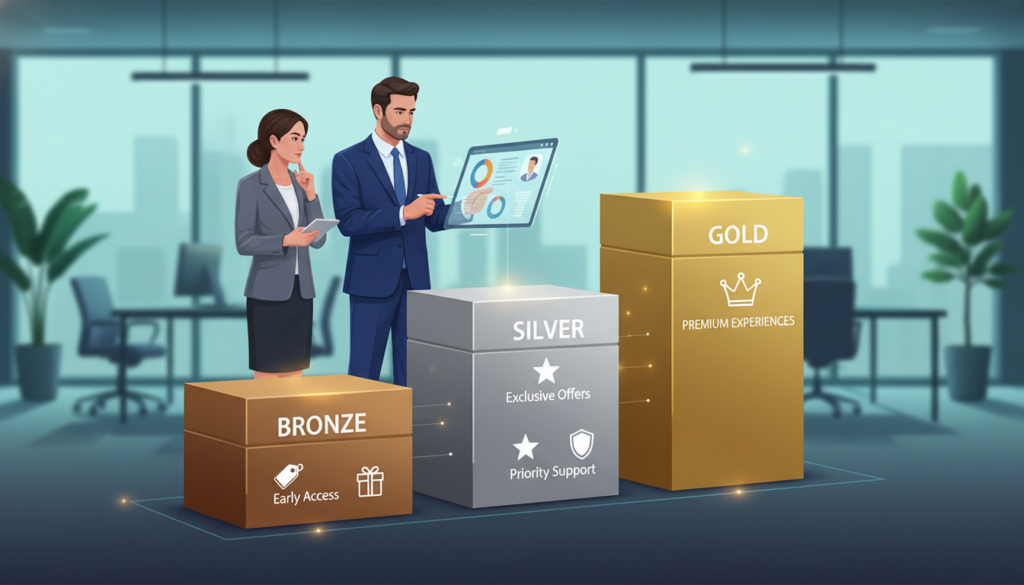
Tiered Milestones: Clients move up levels (like Silver, Gold, Platinum) based on their spending. Each level offers better benefits.
Partnership or Coalition Programs: You work with other vendors to offer rewards together. This makes your program more valuable.
Each model has its own benefits. Spend-based programs boost sales right away. Tiered systems encourage long-term goals and status. Partnership models help you stand out in a crowded market.
Points vs. Tier-Based Systems
Choosing between points and tier systems is key. Points systems are flexible, letting clients use points for various rewards. They’re good for encouraging specific purchases.
Tier systems, on the other hand, offer a sense of elite membership. Clients aim for higher status, which brings perks like special account managers and priority support. The desire for status can keep clients loyal.
We found a hybrid model works best. Clients earn points for all purchases and can redeem them. Their spending also puts them in a tier, giving them ongoing benefits. This mix offers immediate rewards and long-term value.
Customizing Offers for Clients
Generic rewards don’t work well in B2B. Different clients have different needs. A tiered pricing CRM is crucial for customization.
This CRM lets us set up unique discounts and offers for different clients. Instead of handling each deal manually, we use rules in the CRM. These rules depend on the client’s tier, spending history, and potential.
For example, the system can automatically give a discount at checkout for “Strategic” tier clients. It can also offer free training sessions when a “Partner” tier client meets a spending goal on a new product.
The table below shows how customization can vary by client segment:
Client Segment
Primary Reward Focus
CRM Automation Example
High-Volume, Price-Sensitive
Direct rebates & bulk discounts
Auto-apply tiered pricing based on quarterly volume.
Growth-Focused Partners
Co-marketing funds & sales enablement
Trigger access to a co-op marketing portal upon tier promotion.
Strategic Enterprise Accounts
Dedicated support & product roadmap input
Automatically assign a dedicated success manager and schedule quarterly business reviews.
Using tiered pricing CRM tools, we create a personalized yet efficient system. It’s tailored to each client but easy to manage at scale. This ensures your loyalty program is both effective and manageable.
Leveraging Data for Personalization
Raw data becomes actionable intelligence when funneled through a strategic CRM. This unlocks hyper-personalized loyalty experiences. We move from simple transaction tracking to anticipating client needs.
We build stronger relationships by showing we understand their unique business challenges. This makes our programs more than just transactions.
Effective customer marketing in the B2B space relies on this depth of insight. It transforms generic communication into relevant dialogue. Our goal is to make every interaction feel specifically designed for the recipient.
Collecting Customer Data through CRM
Our CRM acts as the central hub for all client intelligence. We systematically gather data points that paint a complete picture of each relationship. This goes far beyond basic contact information.
The most valuable data for loyalty logic includes:
Purchase History: Order frequency, product preferences, and seasonal buying patterns.
Support Interactions: Ticket history and resolution notes that reveal pain points.
Content Engagement: Downloads of whitepapers, views of training videos, and webinar attendance.
This combined view allows us to score engagement and predict future needs. We see not just what clients buy, but how they interact with our entire ecosystem.
Utilizing Data for Targeted Campaigns
Collected data fuels highly specific campaigns. We recently identified a segment of manufacturing clients who regularly purchased a core component but had not accessed our new advanced troubleshooting portal.
Our campaign offered exclusive points for completing a portal tutorial. The creative assets used industry-specific terminology and highlighted time-saving benefits. Logistically, we triggered personalized emails directly from our CRM, based on the client’s purchase history.
The campaign achieved a 40% higher open rate than our broad newsletters. This is the power of data-driven customer marketing. It ensures our offers hit the mark by solving a known, specific need.
Analyzing Engagement Metrics
Launching a campaign is only the first step. We continuously measure its impact to refine our approach. Key metrics tell us what truly resonates with our wholesale partners.
Within our B2B loyalty program software, we track metrics like campaign open rates, reward redemption velocity, and feedback scores on offers. We analyze which reward types drive the most engagement from different segments.
This analysis creates a feedback loop. Poorly performing campaigns signal a need to adjust our messaging or reward structure. High engagement confirms our data segmentation is accurate. This cycle of test, measure, and optimize is central to our strategy.
Using robust B2B loyalty program software for this analysis provides clear dashboards and reports. It turns raw data into a roadmap for program improvement and deeper client relationships.
Creating Compelling Rewards and Incentives
After designing your loyalty program, it’s time to add incentives that clients really want. The rewards you offer are key to keeping clients engaged. They must provide clear, tangible value that strengthens your partnership.
Crafting these B2B rewards needs a deep understanding of what motivates your wholesale clients. It’s not just about the price.
Types of Rewards that Resonate
Effective incentives come in two main types: monetary and strategic value. Mixing both often works best.
Monetary & Discount Incentives: This includes annual rebates, volume-based bonuses, and exclusive tiered pricing unlocked through loyalty tiers. These provide immediate, quantifiable value.
Strategic & Service Perks: Non-monetary rewards can be even more powerful for fostering long-term ties. Examples are dedicated account management, priority support, and co-marketing opportunities that boost the client’s own business.
The most resonant reward is one that solves a specific pain point or opens a new opportunity for your client.
Balancing Cost and Client Satisfaction
Every reward has a cost, so smart financial modeling is essential. We view rewards not as an expense, but as an investment in retention and growth. The key is to align reward value with client lifetime value.
Technology is a powerful ally here. A sophisticated tiered pricing CRM automates the entire process. It can seamlessly apply exclusive pricing or rebate rules based on a client’s loyalty tier or purchase history. This automation ensures our reward delivery is scalable, accurate, and directly tied to performance, maximizing ROI for both parties.
Collaborations and Partnerships for Rewards
You don’t have to build every reward yourself. Strategic partnerships dramatically expand your reward catalog’s appeal without significant internal development cost.
We have successfully partnered with industry-specific software providers, business service firms, and event organizers. These collaborations allow us to offer rewards like complimentary software subscriptions, professional development courses, or premium event tickets. These exclusive offers, curated through partnerships, add a layer of prestige and variety to our B2 rewards program that we couldn’t provide alone.
Ultimately, a compelling reward strategy is a balanced ecosystem. It uses data to understand client desires, employs tools like a tiered pricing CRM for efficient delivery, and leverages external partnerships to enrich the offering. This multi-faceted approach ensures your incentives remain fresh, valuable, and directly contributive to lasting client loyalty.
Ensuring Seamless Customer Experience
A program can fail if it’s hard to use. We make loyalty a key part of doing business with us. This makes it a strong part of our relationship with customers.
We make every touchpoint count. We want benefits to feel earned and access easy. This makes the experience smooth.
Integrating Loyalty Programs with Sales Processes
We made our loyalty program part of our sales workflow. CRM automation shows a client’s status and rewards at every step.
During Quoting: CRM applies discounts based on the client’s tier. Sales reps see this right away.
At Order Placement: The system shows points and promotions. This makes every order special.
Through Invoicing: Points earned are listed on the invoice. Messages about reaching the next tier are sent automatically.
This integration makes things easier. Clients don’t need to remember to apply benefits. The CRM is the source of truth, making loyalty part of their buying habit.
Training Employees for Consistent Messaging
Our people are key to a great experience. We trained our teams to be true ambassadors.
The training covered three main areas:
Knowledge: Understanding the program’s mechanics and benefits.
Context: Knowing how to match rewards with each client’s goals.
Advocacy: Sharing earned benefits and future opportunities.
We gave our teams scripts but encouraged personal touches. This way, every client gets the same enthusiasm, whether it’s their account manager or support line.
Regular Feedback and Adjustments
A program needs to grow. We have feedback loops to keep improving.
Our main feedback tools are:
Quarterly surveys after big interactions.
A “Voice of the Client” channel for informal feedback.
Analysis of program metrics and sales data.
We discuss feedback in monthly meetings. If we see a problem, we can try a fix quickly. This makes our loyalty program a living part of our strategy.
This cycle of feedback and improvement makes our experience seamless. It shows we’re committed to our clients’ success. By making loyalty a part of every interaction, we improve the whole customer journey.
Marketing Your Loyalty Program
A good loyalty program needs a strong marketing push to reach your wholesale clients. Moving into the launch phase is key. We aim to clearly share the program’s value through various channels.
This effort turns your investment into real engagement. It makes the program a key part of your customer marketing efforts.
Strategies for Promoting Your Program
We don’t take a one-size-fits-all approach to marketing. Instead, we craft a plan for each client group. The CRM guides our targeting.
For top clients, we use personal, hands-on outreach. For a wider group, we run digital campaigns that scale. We always highlight the special B2B rewards and business perks.
Here’s a look at the main channels we use:
Marketing Channel
Primary Reach
Relative Cost
Best For
Targeted Email Sequences
High (Direct)
Low
Announcements, personalized offers
LinkedIn & Social Media
Broad & Professional
Medium
Brand authority, program awareness
Virtual Launch Events
High-Value Clients
Medium-High
Deep engagement, Q&A
Account Manager Outreach
Strategic Accounts
High (Time)
Relationship reinforcement
Utilizing Social Media and Email Campaigns
Email is key for our direct customer marketing. We send out sequenced emails to show off the program’s features.
Welcome Series: Explains the program structure and how to earn points.
Educational Content: Shares case studies on how peers use their B2B rewards.
Promotional Blasts: Announces limited-time bonus point opportunities.
On social media, especially LinkedIn, we focus on building our brand. We post about loyalty trends and client success stories.
This approach keeps the program in mind. It also drives traffic to a dedicated page for signing up.
Hosting Launch Events for Awareness
We create special launch events for our most valued partners. Recently, we hosted a virtual event for our top clients.
The event included a live tour of the portal and a Q&A with our leaders. It made clients feel important and heard.
“The launch event didn’t just explain the program; it made us partners in its success. Seeing the tangible B2B rewards upfront was a powerful motivator.”
We used the event to get quick feedback. This helped us make changes before the full launch. The excitement from the event became a key part of our referral strategy.
Marketing your loyalty program is an ongoing effort in customer marketing. It needs consistency and a willingness to adjust based on feedback. By promoting your B2B rewards well, you turn a static program into a dynamic tool for building relationships.
Measuring Success and ROI
Measuring the impact of a loyalty program is more than just looking at numbers. It’s about understanding how clients behave and how we can grow our business. We use real data to measure how well our program is doing. This helps us see if our investment is worth it and how we can get better.
By setting clear goals, our loyalty program becomes a valuable asset. We focus on metrics that show how our program helps us make money. This careful tracking is key to proving and improving our return on investment.
Key Performance Indicators (KPIs) to Track
We keep an eye on a few important KPIs to check how our program is doing. These metrics give us a full picture of how clients are participating and the financial benefits. Each KPI tells us something different.
Member Growth Rate shows how fast our client base is growing. Active Member Percentage tells us how many of our enrolled clients are active. A high sign-up rate is good, but activity is what really matters.
Redemption Rates are very important. They show how often clients use their rewards. If redemption is low, it might mean our rewards aren’t appealing enough.
The most important metrics are Retention Rate and Customer Lifetime Value (CLV). We compare these for program members and non-members. A good program will have higher retention and CLV for members.
KPI
Definition
Why It Matters
Member Growth Rate
The percentage increase in program enrollments over a specific period.
Indicates program appeal and marketing effectiveness.
Active Member %
The proportion of enrolled clients who performed a qualifying action (e.g., purchase, login) in the last quarter.
Measures ongoing engagement, not just initial sign-ups.
Redemption Rate
The percentage of earned points or rewards that clients actually claim.
Direct indicator of reward attractiveness and program communication success.
Member Retention Rate
The percentage of program clients who continue doing business with us year-over-year.
Shows the program’s ultimate goal: fostering long-term loyalty.
Member CLV vs. Non-Member CLV
The average total revenue from a program member compared to a non-member over their relationship.
Quantifies the financial uplift directly attributable to the loyalty program.
Tools for Measuring Loyalty Program Effectiveness
We use a mix of software to collect and analyze our data. Our CRM system is at the center. It gives us real-time insights into client interactions and program status.
Our CRM has advanced features for segmenting clients. This helps us send personalized messages. We also use analytics platforms for deeper insights.
Google Analytics tracks website engagement from loyalty members. Specialized loyalty platforms offer reports on points and redemption. The key is connecting these data sources. A strong tiered pricing CRM is especially useful. It helps us analyze buying patterns across different client segments and pricing levels.
Adjusting Strategies Based on Results
Data is only useful if it leads to action. We review our KPIs every quarter to spot trends and oddities. If active members drop, we check our communication and rewards. Low redemption rates mean we need to rethink our rewards.
This ongoing process turns insights into better performance. We’re not afraid to change course when the data suggests it.
Our biggest change came from analyzing our CRM data. We found a mid-tier client segment wasn’t buying much or redeeming rewards. Their preferences were different from what we thought.
This segment wanted flexible shipping more than discounts. We changed our rewards to include shipping benefits. In two quarters, their activity and spending went up a lot. This data-driven change saved a potentially struggling segment.
Success is a never-ending cycle: track, analyze, adjust, and track again. It keeps our loyalty program fresh, valuable, and in line with what our clients need.
Overcoming Common Challenges in B2B Loyalty
The journey to strong wholesale client retention faces many hurdles. We see these as normal steps in a program’s growth. Recognizing them early and having a plan is key to success.
Addressing Resistance from Clients
It’s common for wholesale partners to be skeptical at first. They might think the program is too complex, not relevant, or a hidden price hike. Our experience shows that being open and showing real value helps.
We tackle this by offering a detailed, hands-on onboarding. It’s not just an email. We have a dedicated session to show how the program benefits their business. We introduce the dashboard, explain the first reward, and answer questions right away.
This personal approach turns skeptics into supporters. It shows the program is a tool for their success, not just a sales trick.
Managing Program Costs
Keeping costs under control is essential. A program that’s too generous can drain resources, while one that’s too tight won’t engage. We manage costs by budgeting wisely and designing smart rewards.
We link every incentive cost to a clear ROI. We focus on rewards that are valuable but don’t cost much, like exclusive data or priority support. For tangible rewards, we use tiered systems where better benefits come with bigger partnerships.
We regularly check redemption rates and program use to adjust spending. This keeps our loyalty strategy profitable, not a financial drain.
Keeping Engagement High Over Time
This is the biggest challenge. Initial excitement can wear off, threatening to lose clients. To keep engagement, we need to keep making an effort.
We plan “program refreshes” to keep things new. This could be introducing new rewards, special bonuses, or fresh partnerships. Our goal is to keep clients excited and engaged.
We also use surprise-and-delight tactics to keep clients excited. An unexpected upgrade, a personalized report, or an exclusive webinar can spark enthusiasm. These gestures show clients they’re valued beyond just a sale.
We fight fatigue by making engagement easy and rewarding. We integrate the program seamlessly with their buying process and keep them updated on their status and rewards.
By tackling skepticism, cost, and fatigue, we build a strong loyalty program. Anticipating these challenges and having solid strategies helps deepen trust. This proactive approach is what drives lasting, profitable client retention.
Future Trends in B2B Loyalty Programs
The world of keeping clients is always changing. To stay ahead, we must look at what’s coming. We aim to create loyalty programs that work today and tomorrow.
The Growing Role of Technology and AI
Today, CRM tools like Salesforce and HubSpot use AI. This tech looks at lots of data to guess what customers might want next. It makes loyalty interactions feel special and personal.
AI picks the best time to offer rewards. This makes every interaction feel valuable and unique.
Sustainability and Ethical Considerations
Businesses now want partners who share their values. There’s a big push for programs that care about the planet and people. We’re adding green options to our loyalty programs.
This includes products made in a responsible way and shipping that doesn’t harm the environment. Clients like working with companies that match their values.
Innovations in Customer Engagement Strategies
We’re moving away from just points and levels. New tech like augmented reality could show off products in a cool way. Blockchain could make it clear how rewards are given out.
We want to create experiences that clients will remember. This will make our partnership stronger.
By following these trends, our loyalty strategy stays fresh. It shows we’re committed to our clients’ success in the long run.
FAQ
What exactly is a B2B loyalty program, and how is it different from a B2C program?
A B2B loyalty program aims to strengthen partnerships with business clients. It rewards their ongoing business and strategic alignment. Unlike B2C programs, which focus on individual transactions, B2B loyalty offers tiered pricing and exclusive support.
It’s about building a partnership that drives predictable revenue. This approach helps retain wholesale clients.
How does a CRM system enhance a B2B loyalty strategy?
A CRM is key to a modern B2B loyalty strategy. It combines all client interactions and purchase history into one view. This allows us to personalize loyalty engagements and automate rewards.
By integrating loyalty logic into our CRM, we create a system where teams can recognize and reward valuable client behavior. This transforms data into stronger customer relationships.
What are the most effective structures for a B2B loyalty program?
The best structures align with clients’ business goals. Common models include spend-based tiers and milestone-based programs. A hybrid approach often works best.
We use our B2B loyalty program software to create escalating benefits. A CRM automates these structures, offering rewards seamlessly as part of the business cycle.
How do you measure the success and ROI of a B2B loyalty program?
We track key performance indicators like member growth and retention rates. We use CRM analytics to monitor these metrics. For example, analyzing tiered pricing CRM usage helps us adjust our strategy for maximum ROI.
What are the biggest challenges in running a B2B loyalty program, and how do you overcome them?
The main challenges are initial skepticism, managing costs, and maintaining engagement. We overcome skepticism with personalized onboarding. We control costs through financial modeling and offering non-monetary rewards.
To combat fatigue, we use surprise-and-delight gestures and regularly refresh rewards. Our program evolves to remain valuable for wholesale client retention.
How important is personalization in B2B loyalty, and how is it achieved?
Personalization is crucial. Generic rewards lack strategic impact. We personalize by using CRM data to segment clients based on potential and fit.
We deploy targeted campaigns through our B2B loyalty program software. This makes every interaction feel tailored and valuable.
Managing promises between businesses is often a slow, unclear process. Old agreements depend on paper and people, leading to delays and arguments.
Now, we have a strong solution. By adding self-running code to platforms, we get clear, automatic agreements. This tech changes how partners agree on and keep promises.
This isn’t just a dream of the future. It’s a real solution today. It makes things more automatic, keeps everything open, and ensures top service quality in B2B partnerships.
Key Takeaways
Traditional SLA management is slow and relies on manual processes.
Automated agreements built on blockchain technology enforce terms instantly.
Integrating this capability into business platforms creates a single source of truth.
Transparency is guaranteed for every party involved in the partnership.
Service quality is assured through pre-defined, automated triggers and actions.
This approach significantly reduces administrative overhead and potential conflicts.
The tools to implement this are operational and available now.
Understanding Smart Contracts in CRM
Today’s CRM platforms are changing. They’re moving from just keeping records to automating tasks. This change comes from adding blockchain-based smart contracts. For B2B deals with Service Level Agreements (SLAs), this is a big step up.
Definition and Importance of Smart Contracts
A smart contract is a self-running agreement. Its rules are written in code and stored on a blockchain. It starts running when certain conditions are met.
This tech is known for being unchangeable and open. Once set up, the contract code can’t be changed. All actions are recorded on a shared ledger, visible to those who need to see it. This builds trust in B2B deals, as everyone can rely on the contract’s logic.
How Smart Contracts Enhance CRM Functionality
A blockchain CRM is key for smart contracts. It’s where businesses manage and interact with their agreements. This makes the CRM more than just a record-keeper; it’s a system that acts on agreements.
In a blockchain CRM, contract details and performance data are linked. For example, if an SLA requires 99.9% uptime, the contract can check this automatically. If met, it can approve and pay; if not, it can alert and enforce penalties. This cuts down on manual checks, reduces disputes, and keeps everyone on the same page.
Aspect
Traditional CRM
Blockchain CRM with Smart Contracts
Contract Storage
Static PDF or document attached to a client record.
Active, executable code linked to the client record and operational data.
Compliance Monitoring
Manual review of reports and data, prone to delay and error.
Automatic, real-time verification against agreed metrics within the blockchain CRM.
Dispute Resolution
Lengthy process based on conflicting records and interpretations.
Transparent, immutable audit trail on the blockchain provides an indisputable record.
Data Verification
Relies on trust in the data source or third-party audits.
Data integrity is cryptographically assured by the decentralized ledger.
Your CRM is now more than just a record-keeper. It actively manages client relationships based on your rules. The whole agreement process, from start to finish, is now automated in your main business platform.
Benefits of Using Smart Contract CRMs for SLAs
Using smart contract CRMs for SLAs brings big wins in many areas. We see real, measurable gains. These systems turn old, stiff contracts into living, breathing tools.
This change helps build stronger partnerships and more reliable business results. Let’s look at the main benefits driving this change.
Increased Transparency and Trust
Old SLAs often hide in static documents or separate systems. This creates info silos. Smart contracts in a CRM change everything.
All agreement terms and performance data are on an unchangeable, shared ledger. Both sides have real-time access to the same info. No confusion or hidden data.
This shared truth builds trust. It’s trust you can check, not just hope for. Every step, delivery, or delay is clear.
This openness stops fights. Teams spend less time arguing and more time working together. The relationship moves from fighting to working together.
Automation of Compliance and Enforcements
Checking SLA compliance by hand is slow and often wrong. Smart contract CRMs fix this. They check conditions against live data all the time.
The best part is automated penalty enforcement. When a service level is broken, the contract acts. No human bias or delay.
For example, the system can:
Calculate and give a service credit to the client’s account.
Send alerts to teams for quick fixes.
Move the issue up to higher management if not fixed.
Log the event for review and audit.
This automated penalty enforcement makes agreements real. It ensures accountability is part of the process, not just written. Businesses know their contracts will be followed exactly.
Cost Reduction and Time Efficiency
Together, transparency and automation lead to big efficiency gains. The main savings are in cutting down on admin work and solving disputes.
Think about the time and money spent on manual reports, adjusting invoices, and legal talks over breaches. A smart contract CRM handles all this.
We see big wins in two main areas:
Area
Traditional SLA Management
Smart Contract CRM
Dispute Resolution
Weeks of emails, calls, and meetings.
Minutes for automated verification and resolution.
Administrative Tracking
Dedicated staff manually compiling reports.
Real-time dashboards with self-populating data.
Enforcement Action
Delayed, manual processing prone to error.
Immediate, precise automated penalty enforcement.
Time efficiency is a big win. Automated workflows free up employee time. Teams can focus on improving, not just following rules.
This leads to faster service cycles and more flexible partnerships. Managing B2B relationships costs less, but the service’s value and reliability go up.
Implementing Smart Contract CRMs in Your Business
For businesses ready to use smart contracts, picking the right CRM is key. You need to find essential features and solve integration problems. This move makes your business more competitive by automating and making SLAs transparent.
Key Features to Look For
Not all smart contract CRM platforms are the same. To manage B2B trustless agreements well, your platform should have certain core abilities.
First, look for a no-code or low-code contract builder. This lets your legal and sales teams create, edit, and deploy contracts easily. They don’t need to know how to code.
Second, secure oracle integrations are a must. These services bring real-world data onto the blockchain. This data can trigger contract clauses automatically and reliably.
Lastly, seamless interoperability with your current systems is crucial. The platform should work well with your ERP, accounting software, and communication tools. It should be a central hub, not a separate unit.
Core Feature
Primary Function
Direct Business Benefit
Visual Contract Builder
Enables drag-and-drop creation of contract logic and terms.
Dramatically reduces legal overhead and speeds up agreement finalization.
Decentralized Oracle Network
Connects smart contracts to verified external data feeds and events.
Ensures automatic, tamper-proof execution based on real-world performance.
Open API Framework
Provides standardized connectors for legacy and modern business software.
Facilitates smooth data flow, creating a single source of truth across departments.
Immutable Audit Trail
Records every contract action and state change on a distributed ledger.
Builds unparalleled transparency and forms the backbone of B2B trustless agreements.
Integration Challenges and Solutions
Adoption can face obstacles. Knowing these challenges early helps plan better.
Technical Complexity: Integrating blockchain can seem hard. Partner with vendors who offer support, detailed guides, and managed services. They handle the tech behind the scenes.
Legacy System Compatibility: Your current CRM and databases aren’t made for this. Use a phased approach with middleware or API-led connectivity. This lets you modernize without a big disruption.
User Adoption Resistance: Teams might be slow to change. Explain the benefits clearly and offer training. Start with a small pilot to show value in a safe way.
The best implementations are gradual. They start with one process, show its value, and then grow. This builds trust step by step.
By tackling these areas with the right solutions, businesses can make the transition smoothly. A phased rollout reduces risk and lets teams adjust. The goal is a system where B2B trustless agreements work automatically, improving cooperation and performance.
Future Trends in Smart Contracts and CRM
Smart contracts are just starting to blend with CRM platforms. Soon, they will be more than just tools; they will be proactive partners in B2B relationships. This is especially true in a decentralized business world.
The Role of AI and Machine Learning
Artificial intelligence will make smart contract CRMs even more powerful. AI can look at past data to predict when SLA breaches might occur. Machine learning will then suggest the best contract terms based on current performance.
This creates a cycle where partnerships keep getting better. It’s a self-improving process for managing business relationships.
Predictions for B2B Service Level Agreements
SLAs will change from being fixed documents to dynamic, data-driven tools. They will adjust automatically based on market changes or performance. Dashboards for real-time compliance will become common.
This change will give businesses the ability to adapt quickly. It’s a big step towards greater agility.
Evolving Legal Frameworks and Best Practices
For widespread use, clear legal standards are needed. Governments are starting to recognize smart contracts as legally binding. Industry groups will also set standards for code audits and resolving disputes.
This legal progress will give businesses the confidence they need. It’s a step towards a more connected and automated future.
Smart contract CRMs are a crucial part of this future. They will help businesses work together securely in a decentralized world.
FAQ
What exactly is a smart contract CRM for B2B SLAs?
A smart contract CRM uses blockchain technology in customer relationship management. It makes B2B Service Level Agreements (SLAs) into self-executing code. This code is on a transparent ledger, making agreements dynamic and automated.
How do smart contracts in a CRM build more trust between businesses?
Smart contracts in a CRM increase trust through clear, automated rules. Everyone can see the same record of the contract and performance. This means no disputes over service credits, making agreements more reliable.
What are the main cost benefits of using this system for SLA management?
Using this system cuts down on administrative work and disputes. It automates monitoring and enforcement, saving time and money. This makes partnerships more efficient and predictable.
Isn’t the technical complexity a major barrier to implementing a blockchain CRM?
While it’s complex, modern solutions make it easier. Look for platforms with no-code or low-code builders. Start with a simple SLA to build skills, and choose solutions that work with your current systems.
How does automated penalty enforcement actually work in practice?
Automated penalty enforcement is built into the smart contract. For example, if uptime falls below 99.9%, the system automatically issues a service credit. This happens without any human intervention, enforcing the agreement impartially.
What role will AI play in the future of smart contract CRMs?
AI will revolutionize smart contract CRMs by making them proactive. It will analyze data to predict and prevent breaches. AI will also help in setting optimal contract terms, making agreements more dynamic and valuable.
Are smart contract-based SLAs legally binding?
Smart contract SLAs are becoming legally recognized. The code acts as the contract, and its outputs are undeniable. Legal frameworks are evolving to support these agreements, making them binding.
For years, our sales and marketing teams worked alone. This made things hard and wasted time. Marketing made leads that sales didn’t care about. Sales chased accounts that marketing didn’t back.
We found a solution by putting Account-Based Marketing into our CRM. It was more than a new way to do things. It changed how we worked. Our CRM became the key place for our target accounts.
This story shows how we fixed big problems. We solved slow pipelines and small deals. Using our CRM, we made our strategy real and showed its impact. Our team and revenue grew a lot.
Key Takeaways
Siloed sales and marketing teams create friction and waste resources.
Implementing ABM in your CRM is an operational shift, not just a tactic.
A unified strategy requires a single source of truth for target accounts.
This approach directly addresses core business problems like pipeline speed.
The result is measurable impact on deal size and overall revenue.
Alignment turns departmental efforts into a cohesive revenue engine.
Understanding Account-Based Marketing (ABM)
ABM is like spearfishing, focusing on specific high-value accounts. It’s different from traditional marketing that casts a wide net. A good ABM program starts with the right ABM software. This tech is key to success.
What is Account-Based Marketing?
ABM is a strategic approach where sales and marketing team up. They target specific accounts, treating each as its own market. They aim to build strong relationships and close deals faster.
Approach
Target
Content
Primary Goal
Measurement
ABM
Specific, named accounts
Hyper-personalized, account-specific
Engage and convert key accounts
Account engagement, pipeline velocity, deal size
Traditional Lead-Based
Broad segments or personas
Generalized, one-to-many
Generate maximum leads
Lead volume, cost per lead, MQLs
The table shows the big difference. ABM is a focused strategy, not just a tactic. It meets each customer’s unique needs and journey.
Key Principles of ABM
Our program followed key principles. These made our efforts systematic and measurable.
Strategic Account Selection: We picked high-value accounts based on data and ideal customer profile. This ensured we focused on the best opportunities.
Personalized, Multi-Channel Engagement: We used email, social, and direct mail for tailored interactions. Every touchpoint was specific to the account.
Deep Sales and Marketing Alignment: Both teams had the same goals and metrics. Regular planning sessions helped keep everyone on the same page.
Continuous Measurement and Iteration: We tracked engagement and pipeline influence. This data helped us improve our strategy over time.
These principles need strong orchestration. The right ABM software is crucial. It manages data, automates outreach, and tracks impact.
Benefits of ABM for Businesses
ABM brought real benefits to our organization. The advantages went beyond marketing metrics.
Improved Sales Efficiency: Sales teams focused on high-potential accounts. This shortened sales cycles and boosted win rates.
Higher Marketing ROI: Marketing budgets went to targeted campaigns. This led to a better return on investment.
Stronger Customer Relationships: Personalized engagement built trust. This often led to bigger deals and advocates for future growth.
Better Resource Allocation: With a clear list of target accounts, teams could align efforts. This reduced duplication and created a united front to customers.
These benefits add up over time. They make revenue more predictable and efficient. The right tech enables a scalable ABM strategy.
Integrating ABM with CRM Systems
ABM and CRM together create a powerful engine for growth. This combination turns scattered data into a unified force. It makes ABM a real, measurable strategy.
Our experience shows that a strong account-based marketing CRM connection is key. It separates the best from the rest.
We see our CRM as the heart of all account-based activities. It needs strategic planning and technical setup. Let’s look at the essential features, steps, and tools for this connection.
Essential CRM Features for ABM
Not all CRMs are good for ABM. We have clear criteria for the must-have features. A good platform goes beyond basic contact management.
It must enable precision targeting and coordinated efforts. Here are the key features we focus on:
Feature
Description
Critical Role in ABM
Account Scoring & Tiering
Ability to score and rank accounts based on firmographic, technographic, and engagement data.
Focuses resources on high-potential target accounts, moving beyond lead-centric scoring.
Campaign & Touchpoint Attribution
Tracks all marketing interactions (emails, web visits, content downloads) and attributes them to specific accounts.
Provides clear ROI measurement for ABM campaigns and shows marketing’s impact on pipeline.
Task & Workflow Automation
Automates repetitive tasks (e.g., assigning leads, sending alerts, scheduling follow-ups) based on account behavior.
Ensures timely, consistent engagement across sales and marketing teams at scale.
Unified Account & Contact Views
Consolidates all data points—from both marketing and sales activities—into a single, holistic account profile.
Eliminates silos, giving every team member a complete picture of the account’s journey and health.
Steps to Integrate ABM into Your CRM
Setting up an account-based marketing CRM strategy is a step-by-step process. We follow a careful plan to avoid disruption and ensure everyone adopts it.
Audit and Clean Your Existing CRM Data. Start by removing old contacts and standardizing data. This makes your data clean and ready for scoring and targeting.
Define Your Account Scoring Model. Work with sales to decide what makes an account ideal. We use factors like industry and technology stack to score accounts.
Configure Campaign Tracking and Attribution. Set up campaign tracking and attribution. This lets you see how each account interacts with your marketing efforts.
Design and Automate Key Workflows. Automate alerts and tasks for sales based on account behavior. This streamlines your efforts and keeps everyone on track.
Train and Align Your Teams. Make sure everyone knows how to use the new account-based marketing CRM system. This ensures everyone works towards the same goals.
Tools that Enhance ABM and CRM Collaboration
While a good CRM is key, specialized tools can boost your ABM efforts. These tools work with your CRM to fill gaps and provide deeper insights.
We focus on three areas: intelligence, orchestration, and analytics. Our goal is to create a seamless ecosystem where data flows freely.
Intent Data Platforms (e.g., Bombora, G2): These tools show which accounts are researching your solutions. This data boosts account scores and triggers sales outreach.
Engagement Orchestration Platforms (e.g., Terminus, 6sense): They let us run ABM campaigns across channels. All engagement data is synced back to our CRM.
Predictive Analytics & Scoring Tools: These tools use AI to analyze our data, predicting which accounts will convert. They improve our scoring models.
The best account-based marketing CRM setup is invisible. Sales gets insights without extra effort, and marketing can see the impact on pipeline growth.
By combining a feature-rich CRM with these tools, we’ve broken down barriers. This collaboration turns our CRM into a living system that drives revenue, not just reports on it.
Developing Effective ABM Workflows
The power of Account-Based Marketing comes from well-planned workflows. These workflows guide every interaction, turning strategy into action. For our B2B targeted marketing, we create workflows that are both structured and flexible.
This ensures our sales and marketing teams work together. They deliver a unified experience to high-value accounts. We focus on three main areas: journey mapping, content personalization, and success measurement.
Mapping Customer Journeys in ABM
ABM needs detailed, multi-touchpoint journeys for each account. We identify every possible interaction a key decision-maker might have with our brand.
Our mapping process includes several key steps:
Researching Account Stakeholders: We find all influencers, champions, and final decision-makers within an account.
Identifying Pain Points: We document the specific challenges and goals for each stakeholder role.
Charting Touchpoints: We plot out all possible channels—emails, LinkedIn messages, webinars, sales calls—and sequence them logically.
Assigning Team Roles: Clear responsibilities are set for marketing (content, nurture) and sales (direct outreach, meetings).
This detailed approach lets us anticipate needs and deliver the right message at the right time. It turns our B2B targeted marketing into a guided conversation.
Crafting Personalized Content for Target Accounts
Once the journey is mapped, we fill each touchpoint with hyper-personalized content. Our method goes beyond using a contact’s first name in an email. We create assets that speak directly to an account’s unique business context, recent news, and stated challenges.
For example, we might develop a tailored case study showcasing how we solved a problem for a competitor in their industry. Or, we could create a brief executive summary addressing a specific initiative mentioned in their annual report.
“Personalization at scale isn’t about millions of variations; it’s about making a handful of accounts feel like they’re the only one that matters.”
Our outreach sequences blend this customized content across channels. A typical sequence might start with a personalized video message from an account executive, followed by a relevant industry report, and then an invitation to an exclusive peer roundtable.
Measuring ABM Workflow Success
What gets measured gets improved. We establish clear KPIs to track the effectiveness of our ABM workflows from engagement to revenue. This data-driven approach allows us to optimize continuously.
Opportunities created, pipeline velocity, deal size influenced by ABM
Measure impact on sales funnel
Revenue Attribution
Revenue from target accounts, ROI, customer lifetime value (CLV)
Prove financial return and program value
By tracking revenue attribution, we move beyond vanity metrics. We can directly tie closed-won deals to specific workflow activities. This proves the value of our B2B targeted marketing efforts and secures ongoing investment.
Regular workflow reviews are essential. We analyze what’s working—which content types drive meetings, which touchpoints accelerate deals—and double down on those successes. This cycle of execution, measurement, and refinement is what makes ABM workflows a sustainable engine for growth.
Overcoming Challenges in ABM Implementation
Starting a successful Account-Based Marketing program comes with its own set of challenges. We’ve learned a lot to help you steer clear of common problems.
Common Pitfalls to Avoid in ABM
One big mistake is picking accounts without a clear plan. We changed our approach to focus on accounts that really fit and have potential. Another mistake is starting campaigns without the support of top executives. Getting their backing early helped us get the resources we needed.
Also, using bad data for high-value account targeting can lead to failure. We improved our targeting by combining firmographic and intent data in our CRM.
Strategies for Aligning Sales and Marketing Teams
We started weekly meetings where sales and marketing work together. They review target accounts and pipeline health. This teamwork helped them focus on making money, not just getting leads.
They use a shared CRM to add notes and track interactions live. This way, both teams are always on the same page.
Ensuring Continuous Improvement in ABM Practices
Our ABM success comes from always getting better. We have quarterly reviews to see what’s working. Feedback from sales reps helps our content stay on point.
We also update our playbooks based on how well our campaigns are doing. This cycle of learning makes our high-value account targeting better over time.
By tackling these challenges head-on, we turned our ABM into a powerful tool for driving revenue.
FAQ
What is Account-Based Marketing (ABM), and how does it differ from traditional marketing?
Account-Based Marketing focuses on specific, high-fit accounts. It’s different from traditional marketing, which aims for many leads. ABM uses personalized outreach and multi-channel engagement for each account.
Why is integrating ABM with a CRM system so important?
Integrating ABM with our CRM changed our strategy. It made our marketing efforts scalable and operational. Our CRM tracks engagement, automates tasks, and aligns sales and marketing teams.
What are the essential CRM features needed for a successful ABM program?
Key CRM features for ABM include account and contact management, scoring, and campaign attribution. Automation and detailed reporting are also crucial. These features help target high-value accounts effectively.
How do you measure the success of ABM workflows?
We measure ABM success with specific KPIs. These include account engagement scores and pipeline velocity. We also track deal size, revenue, and ROI to gauge performance.
What are the most common pitfalls to avoid when starting with ABM?
Avoid choosing target accounts based on gut feeling. Don’t skip executive buy-in and budget. Treating ABM as a marketing-only initiative is also a mistake. It needs sales and marketing alignment.
What tools can enhance the collaboration between ABM activities and CRM data?
Tools like Terminus and Demandbase improve ABM and CRM collaboration. They offer intent data and analytics. Integration platforms like Zapier ensure data flows smoothly, empowering personalized outreach.
How do you ensure continuous improvement in your ABM practices?
We improve ABM through regular meetings and data analysis. We adapt our strategies based on performance data. Feedback from sales on content and account responsiveness helps us scale our success.
Many organizations face a big challenge with old enterprise data. This data, stuck in outdated systems, uses up resources and poses hidden risks.
Keeping old operational records is tough. Storage costs keep going up, hurting the company’s finances. Also, old data slows down current system performance.
Compliance and legal rules make things even harder. Laws often require access to old records for years. A smart, cost-saving archiving plan is not just helpful—it’s necessary.
This plan is key for keeping operations running smoothly and following the law. We’ll share a tested method. It turns old data from a problem into a valuable, easy-to-find resource.
Key Takeaways
Old ERP records are a big problem for companies, affecting both operations and finances.
Storage costs for old data keep going up, hurting the company’s bottom line.
Keeping old data in active systems slows down current users.
Legal and regulatory rules often require safe, long-term access to old business records.
A smart archiving plan is crucial for keeping operations healthy and managing risks.
With the right plan, old data can be turned from a problem into a controlled asset.
Understanding ERP Data Archiving Basics
ERP data archiving is more than just moving old files. It’s a smart way to manage your digital history. First, you need to know what archiving is, why it’s important, and its benefits. This knowledge makes the project clear and focused.
What is ERP Data Archiving?
ERP data archiving means moving old business data to a safe place. It’s different from backups, which are for disaster recovery. And it’s not about deleting data forever.
Archiving keeps data safe while freeing up space. We move data from the main database to a backup system. This data is still complete and legal, but it doesn’t slow down your work.
Why is ERP Data Archiving Important?
Keeping old data in your main system is a big problem. It makes your database bigger and slower. This costs more money and makes your system less efficient.
Archiving helps manage old data safely. It keeps your system fast and your business running smoothly. It also helps with data rules and legal issues.
Effective archiving is a smart investment. It makes your system better and keeps you safe from legal trouble.
Key Benefits of Archiving ERP Data
Organizations that archive their data see big benefits. These benefits make a strong case for starting an archiving program.
Superior System Performance: A clean database means faster work and better reports. Users get a better experience.
Reduced Infrastructure Costs: You can save money on upgrades by storing old data elsewhere. This is cheaper and more efficient.
Enhanced Data Governance: Archiving makes it easier to follow data rules. It helps with audits and keeps you in line with laws.
Improved Disaster Recovery: Smaller databases are easier to back up and restore. This means less downtime for your business.
Informed Decision-Making: Old data is still useful for analysis and planning. It becomes a valuable resource for your business.
Understanding these basics is the first step to a successful archiving project. It helps control costs, reduce risks, and improve your ERP system.
Challenges of Archiving Old ERP Data
Archiving old ERP data is complex. It involves technical, legal, and operational challenges. Projects often fail due to human and procedural issues, not just technology. This section highlights the main obstacles you might face.
Common Pitfalls in Data Archiving
Many start archiving with excitement but hit roadblocks quickly. Poor planning is a big issue. Teams often dive into extraction without knowing the data’s structure and volume.
Scope creep is another problem. What starts as archiving five years of financial records can grow to include a decade of customer service logs. This can strain budgets and timelines.
Underestimating resources is a common mistake. Legacy systems need special knowledge to access, and that expertise may be missing.
Common Pitfall
Typical Impact
Recommended Mitigation
Inadequate Planning
Project delays, budget overruns, incomplete data sets.
Conduct a full data audit and create a detailed project charter before beginning.
Scope Creep
Ever-expanding timelines, ballooning costs, team burnout.
Define strict project boundaries and implement a formal change control process.
Resource Underestimation
Inability to access or interpret legacy data formats.
Inventory required skills early and secure consultants or train staff in advance.
Ignoring Data Dependencies
Archived records become useless because related files are missing.
Map all data relationships and archive interconnected records as a single unit.
Compliance and Legal Considerations
Legal compliance is crucial. A simple storage decision can lead to serious legal issues. Regulations like GDPR, HIPAA, and Sarbanes-Oxley have strict rules for compliance data retention.
These laws dictate how long you must keep certain records. They also outline rules for secure access and destruction. Archiving outside these guidelines can lead to fines and legal trouble.
Failing to produce a legally required document from an archive because it was purged too early can be deemed spoliation of evidence, carrying severe court penalties.
Your archiving strategy must follow these rules. We start by identifying which regulations apply to each data type. This ensures the archive supports your legal obligations.
Managing Data Quality and Integrity
Ensuring data accuracy and usability is a major challenge. The extraction process can introduce errors. A corrupted file from a 20-year-old system is useless to a future auditor.
We use a multi-step verification process. First, we run checksums on extracted data to confirm nothing was altered during transfer. Second, we sample records and compare them to the original source for accuracy.
Maintaining integrity also means preserving context. An invoice number is useless without the corresponding purchase order. Our methods archive related data in logical groups, ensuring future users get the complete picture.
This proactive approach turns your archive into a trusted, long-term business resource.
Cost-Effective Strategies for Data Archiving
To make archival more valuable, organizations need to use modern tech and smart management. The goal is to keep data useful while saving money. We focus on three key strategies for managing old ERP records.
Leveraging Cloud Solutions for Storage
Cloud storage is great for archiving because it’s scalable and on-demand. You don’t have to buy and maintain lots of hardware. Instead, you only pay for what you use.
But, managing cloud storage costs is crucial. Without good management, costs can rise as data grows. Here’s how to manage:
Select the Right Storage Class: Use archival or cold storage for data you don’t access often. These options are cheaper but take longer to retrieve.
Implement Lifecycle Policies: Move data to different storage tiers based on how often it’s accessed. Data accessed rarely doesn’t need expensive storage.
Monitor and Optimize: Check storage reports often. Delete data that’s no longer useful to save money.
Using the cloud wisely makes it a cost-effective archival tool.
Implementing Hierarchical Storage Management
Hierarchical Storage Management (HSM) automates where data is stored. It puts data on the cheapest storage that meets its needs.
An HSM system has a clear structure. “Hot” data stays on fast storage. “Warm” data goes to slower storage. “Cold” data goes to the cheapest storage, like tape or cloud.
This approach saves money. You’re not paying for data that’s not used. HSM moves files automatically, saving resources. For old ERP data, HSM can save a lot.
Automation Tools for Efficient Archiving
Manual archiving is slow and can be expensive. Automation is key to saving money. It follows policies, saves labor, and keeps data safe.
We use special tools for archiving:
Data Classification and Tagging: Tools scan and classify data. They decide what to archive and apply labels.
Policy-Based Migration: Classified data is moved to its storage tier automatically. This follows a set schedule.
Compliance and Legal Hold: Automation keeps data under legal hold safe. This reduces risk.
For example, we use Informatica or IBM Spectrum Protect. They archive old transaction records to cold storage. This keeps master data easy to access. This approach is consistent and lets IT focus on other tasks.
These strategies—smart cloud use, tiered storage, and automation—work together. They help keep important business history without breaking the bank.
Best Practices for Long-Term Data Access
The success of an ERP data archiving project is seen years later. We must make sure archived info stays useful, not a hidden expense.
Ensuring Data Retrieval Ease
A simple way to find data is key. Use strong indexing and detailed metadata. This lets users find records fast, without needing the live ERP system.
Regular Review and Update of Archived Data
Business needs and laws change. Set up yearly checks on your archived data and how long you keep it. This keeps your archive up-to-date and valuable.
Training Staff on Archiving Policies and Procedures
Staff keeps the system running. Train them on how to archive and retrieve data right. This builds a culture of data management in your company.
By following these steps, archiving becomes a lasting part of your business. It protects your investment and keeps data useful for years. A well-managed archive is essential for a mature data lifecycle.
FAQ
What exactly is ERP data archiving?
ERP data archiving moves old, rarely used business records to a safe place. It’s not just a backup. It’s a way to keep data for legal or business reasons. This makes your main system run faster.
Why is archiving old ERP data so important for my business?
Keeping old data on your main system slows things down. It makes backups longer and costs more. It also makes it hard to find records for audits or legal needs.
Archiving fixes these problems. It turns old data into something useful.
What are the key benefits of implementing an ERP data archiving solution?
Archiving makes your ERP system faster and more stable. It also saves money by using cheaper storage. This makes your IT setup simpler and better managed.
What are the biggest pitfalls to avoid when starting a data archiving project?
Don’t skip planning and underestimate the time needed. Make sure to include legal data rules from the start. This avoids legal trouble and saves storage space.
How can archiving be truly cost-effective with today’s technology?
Use smart storage and automation to save money. Cloud storage is flexible and affordable. But, plan it well to avoid high costs later.
Automate archiving to cut down on mistakes and save time. This makes your investment worth it.
If data is moved to a low-cost archive, how do we ensure it can be retrieved easily when needed?
Make sure archived data is easy to find and use. Use a simple system for searching and restoring data. This way, finding old records is as easy as using the live system.
How often should we review our archived data and policies?
Check your data and policies at least once a year. Business and laws change. A yearly check keeps your data and policies up to date.
This keeps costs down and follows the law over time.
The most critical sales period of the year is not the time to discover your technology can’t keep up. For B2B companies, peak season is a huge chance and a big risk. Your whole operation depends on your Cloud Enterprise Resource Planning system’s performance.
When sales go up, a slow or crashed system is a big threat to your income. It can hurt your client relationships and damage your brand’s trust quickly. But, you can avoid this with the right preparation.
Proactive stress-testing is the key solution. It helps IT teams move from just fixing problems to being in control. A solid ERP load testing plan is the foundation of this approach.
By testing your system with real traffic before it hits, you get crucial data. This shows you any hidden problems and checks if your system can handle it. The outcome is operational resilience that boosts sales and makes customers happy.
Key Takeaways
Peak sales seasons put a lot of demand on your main business systems.
System failure during busy times means losing money right away and hurting your brand for a long time.
Checking your system’s performance ahead of time is a must for today’s businesses.
A planned load testing program mimics real traffic to find weaknesses before they affect customers.
Keeping your system strong protects your sales goals and builds trust with clients.
Good peak season IT prep is a smart investment, not just a technical task.
Understanding ERP Load Testing
ERP load testing is more than just checking how well your software performs. It simulates real-world stress on your enterprise software. It’s a way to see if your system can handle the expected demand. We push cloud ERP platforms to their limits before your busiest times.
This ensures your system can scale reliably. It’s key to keeping your business running smoothly.
What is ERP Load Testing?
ERP load testing is about simulating many users and transactions on your system. We mimic the daily workflows of your sales, inventory, and finance teams. The goal is to see how your system performs under pressure.
This is different from basic testing. We create scenarios that mimic peak times, like order entry and complex reporting. This helps us find hidden problems before they affect your business.
Importance for Cloud Solutions
Cloud ERP solutions promise to scale automatically. But, this depends on proper setup and architecture. Without load testing, you might think scalability is guaranteed, only to face issues during busy times.
Cloud environments have unique challenges like shared resources and multi-tenancy. A good load testing strategy considers these. It ensures your system won’t hit a performance bottleneck unexpectedly. We check if the cloud’s flexibility works for your business.
Key Metrics to Monitor
Good load testing relies on data. We track specific KPIs that show system health and user experience. These metrics help us see how scalable your software is and where performance bottlenecks might be.
Watching the right data helps you make informed decisions. It turns test results into useful insights for your IT and business teams.
Metric
Description
Why It Matters
Response Time
The time the system takes to respond to a user action (e.g., loading a page, saving a record).
Directly impacts user productivity and satisfaction. Slow response times are a primary symptom of a performance bottleneck.
Throughput
The number of transactions the system processes per second (e.g., orders per hour).
Measures the system’s capacity and processing power. It’s a core indicator of enterprise software scalability.
Concurrent Users
The number of users actively interacting with the system at the same time.
Tests the system’s ability to handle realistic user loads without degradation in performance for any individual.
Error Rate
The percentage of transactions that fail or produce errors under load.
Reveals system stability. A rising error rate under load indicates failing components or insufficient resources.
Resource Utilization
CPU, memory, disk I/O, and network usage on servers and databases.
Identifies which hardware or software resources are maxing out, providing a clear target for optimization.
By looking at these metrics together, we can find the cause of slow response times. For example, high database CPU usage. This detailed view is crucial for building a system that can handle peak demands.
Preparing for Peak Season Sales
The key to managing B2B high traffic is to prepare well before the busy season starts. We work closely with our clients during this time. Our aim is to turn uncertainty into a clear plan.
This preparation is crucial for all ERP load testing that follows. We set exact parameters based on real data, not guesses. The process has three main phases.
Identifying Peak Periods
First, we figure out when your system will be under stress. We look at many data sources to find these times accurately. Your ERP system’s past transaction logs are key evidence.
We also check industry calendars and client buying habits. For many B2B businesses, busy times often match quarter-end or before holidays. This helps us spot predictable demand peaks.
By combining your data with outside trends, we get a full picture. We find not just single days, but often whole weeks of high activity. This period is what we focus on for our stress tests.
Forecasting B2B Sales Trends
Forecasting tells us how much load to expect. We project transaction volumes by looking at past peak seasons. We look for growth rates and new clients.
Market analysis adds to this view. We consider economic signs and reports specific to your sector. This helps us guess if the next peak will be bigger than the last.
The forecast gives us real numbers: how many users at once, orders per hour, and data requests. These numbers guide our load testing scripts.
Evaluating System Readiness
Before testing, we check how the system does now. We assess your live cloud ERP system’s performance. This sets a “normal” benchmark.
We see how the system handles usual loads. This covers four main technical areas. The results show where the system is strong and where it might struggle.
Evaluation Area
Key Metrics
Target Threshold
Testing Method
System Response
Page load time, API latency
<2 seconds
Baseline performance test
Concurrent Users
Active sessions, transaction completion rate
Projected peak +20% buffer
Simulated user load test
Database Performance
Query speed, connection pool usage
<100ms average
Database stress test
Integration Points
Third-party API response time, data sync status
<3 seconds
End-to-end workflow test
This readiness check is key for B2B high traffic management planning. It shows us the system’s starting point. We then design ERP load testing scenarios that go beyond these numbers.
The findings from identifying, forecasting, and evaluating merge into a single plan. This data-driven approach makes our load tests realistic and relevant. We simulate the exact pressures your business will face, preparing your cloud ERP to handle the peak season well.
Common Load Testing Strategies
Effective load testing strategies are key for any peak season IT prep plan. We use proven methods to check if systems are ready for high loads. This ensures your cloud ERP can grow when sales peak.
We are careful and methodical. Our focus is on three main areas: making user simulations real, using the right tools, and testing safely. This approach is crucial for checking enterprise software scalability.
Simulating Real User Loads
Creating accurate simulations is our first step. We make detailed scripts that show real business actions. These scripts go beyond simple actions to include complex transactions.
We model scenarios like placing many orders at once, checking inventory, and making reports. Each script includes pauses, different data, and error handling to act like real users. This shows how systems perform under real pressure.
Without this detail, tests can be misleading. Our aim is to find problems before they affect users, a key part of peak season IT prep.
Tools for Effective Load Testing
Choosing the right tools is important. We use top solutions for their reliability and detailed analysis. The best tool gives us exact data and useful insights.
We often use a mix of tools:
Apache JMeter: A favorite for its flexibility and detailed reports.
Micro Focus LoadRunner: Great for complex apps and simulating many users.
Cloud-based Services: Like AWS or Azure, they offer scalable, on-demand testing.
These tools help us create and test high volumes of traffic. They give us precise data to prove enterprise software scalability under heavy loads.
Testing in a Staging Environment
Testing live systems is risky. We test in a dedicated staging area that mirrors production.
This area has the same hardware, network, and data as production. Testing here has big benefits:
Zero Operational Risk: Tests won’t affect live business or harm customer data.
Realistic Performance Baselines: Results show how production will perform, allowing for safe improvements.
Iterative Improvement: Teams can make and test changes without worrying about downtime.
This is a key part of our method. It’s the only safe way to test your enterprise software scalability and finish your peak season IT prep with confidence.
Benefits of ERP Load Testing
ERP load testing shows its true value in real benefits to an organization. It turns theoretical plans into real resilience. This proactive approach makes a big difference.
This effort pays off in three key areas: system health, user satisfaction, and risk reduction.
Enhanced System Performance
Load testing is like a health check for your cloud ERP. It checks how the system performs under stress. The main benefit is finding and fixing hidden performance bottlenecks before users face them.
These bottlenecks can hide in database queries, code, or server settings. By simulating peak loads, we find these issues. Then, teams can fix them:
Database indexing for faster reports
API call efficiency for modules
Server resource allocation for user spikes
This makes the system efficient during peak times. It keeps transaction speeds and data processing fast.
Improved User Experience
User experience is key for B2B commerce. A slow system slows down sales teams and buyers. Load testing ensures the ERP is fast during important moments.
When account managers check client history or buyers make big orders, speed is crucial. Testing makes sure these workflows are smooth. This boosts team productivity and client satisfaction.
A fast system empowers users. It removes tech frustration, letting people focus on their goals.
Reducing Downtime Risks
The biggest benefit is reducing downtime risks. Unplanned downtime can hurt finances and reputation. Load testing helps avoid this.
“The average cost of IT downtime is $5,600 per minute. For critical business applications, that figure can be much higher.”
By testing the system to its limits safely, we find and strengthen weak points. This is crucial for B2B high traffic management during big events.
This practice:
Minimizes revenue loss by preventing cart abandonment and order halts.
Protects brand reputation by ensuring reliable service when needed.
Reduces emergency support costs by avoiding system crashes.
In summary, ERP load testing makes your organization proactive. It builds confidence, ensuring your ERP is strong for growth, not a weak point.
Key Challenges in Load Testing
Testing an enterprise system is complex. It involves technical and financial hurdles. ERP load testing is key but faces challenges that can affect its success. Teams must tackle these issues to protect their enterprise software scalability during sales peaks.
Handling Data Complexity
Cloud ERP systems have complex data models. A single transaction can update many areas. This makes load testing hard.
Tests need realistic, large amounts of data. Simple or fake data won’t show real problems. Teams often struggle with:
Creating test data that matches real volumes.
Keeping data relationships and integrity under load.
Forecasting how complex queries and reports will perform.
Ignoring data complexity can give false security.
Testing Diverse User Scenarios
During sales peaks, many user roles work together. A finance clerk, sales reps, and warehouse staff all act at once. It’s hard to model this diversity.
Good ERP load testing scripts these different workflows. Each role puts different pressure on the system. Common mistakes include:
Focus on one department, ignoring others.
Not simulating real user patterns and “think time.”
Underestimating the mix of tasks during peak times.
This requires a deep understanding of business processes.
Budget Constraints for Testing
Getting funds for load testing can be tough. Leaders might see it as unnecessary. Framing it as a risk mitigation strategy helps.
We justify the cost by showing the risk of system failure. This links the budget to ensuring enterprise software scalability. Look at these financial points:
Lost Revenue: The cost of sales lost due to system issues.
Operational Halts: The cost of delays in shipping or finance.
Brand Damage: The impact on customer trust and retention.
Seeing load testing as insurance changes its view from cost to value.
Overcoming these challenges is essential. It’s needed for the scalable operations of top B2B companies.
Tools and Technologies for ERP Load Testing
Choosing the right tools is key to getting your cloud ERP ready for peak sales. The right tech stack helps us test loads, find breaking points, and ensure smooth performance. This is the core of any serious peak season IT prep plan.
The landscape includes dedicated load testing software and scalable cloud platforms. Each has its own role in testing. Our goal is to create a test environment that matches real B2B high traffic management scenarios.
Popular ERP Load Testing Tools
Many tools are popular for load testing. They range from open-source to enterprise suites. The choice depends on budget, expertise, and ERP modules.
Open-source tools like Apache JMeter and Gatling are cost-effective and customizable. Commercial tools like Micro Focus LoadRunner and IBM Rational Performance Tester offer advanced features for complex ERPs like SAP or Oracle.
The table below compares key players:
Tool Name
Type
Key Strength
Best For
Apache JMeter
Open-Source
Flexibility & extensive plugins
Teams with Java expertise
Micro Focus LoadRunner
Commercial
Protocol support for legacy ERP
Large, heterogeneous IT landscapes
Gatling
Open-Source
High-performance, code-based tests
Developers favoring Scala/DSL
k6
Open-Source/SaaS
Developer-centric, JavaScript scripting
Modern DevOps pipelines
When choosing, we look at the tool’s protocol support and ability to manage session state. It must handle complex user journeys like real B2B transactions.
Cloud Services for Load Testing
Cloud-based load testing services have changed peak season IT prep. They let us avoid big on-premise infrastructures. Instead, we can quickly set up virtual users worldwide.
Services like AWS Load Testing, Azure Load Testing, and BlazeMeter offer great scalability. They can handle sudden, massive loads like sales quarter ends or product launches. This model is often cheaper for seasonal testing.
Elastic Scalability: Instantly scale test loads to match forecasted peak traffic.
Geographic Distribution: Simulate user loads from different regions to test CDN and latency.
Integrated Analytics: These platforms often include advanced dashboards for real-time result analysis.
Cloud services are great for testing your cloud ERP’s elasticity. They check if your auto-scaling rules work under heavy B2B high traffic management conditions.
Integrating Testing Tools with ERP Systems
The best tool is useless if it can’t connect securely to your ERP. Integration is key for realistic tests. It’s more than just pointing the tool at a URL.
We start by setting up secure connections, often using VPNs or whitelisted IPs. Then, we script user behaviors that reflect real business processes. This means scripting multi-step workflows like creating a sales order, checking inventory, and processing an invoice.
Authentic load testing requires the test scripts to log in with real user credentials, navigate business role-specific menus, and handle dynamic data from the ERP’s database.
We use APIs from both the ERP and testing tool for integration. For example, we might pre-populate test data or validate transactions post-execution. The goal is to ensure tests don’t harm live data, so we run them in a staging environment that mirrors production.
This careful integration helps us answer key questions. Can the system process 500 concurrent purchase orders per hour? How does the response time degrade when the database is under peak load? Answering these is the essence of proactive peak season IT prep.
The right tools, scalable cloud services, and deep integration create a reliable testing regimen. This prepares your ERP to handle demanding sales periods with confidence.
Best Practices for Effective Load Testing
Our experience shows that the difference between a successful peak season and a costly outage often lies in the rigor of your load testing practices. True resilience is built by embedding disciplined methodologies into your operational DNA. This section distills our proven lessons into actionable best practices for mastering ERP load testing.
Developing a Load Testing Plan
A robust plan is your blueprint for success. It transforms ad-hoc checks into a structured, repeatable process. Every effective plan must clearly define three core components: objectives, success criteria, and rollback procedures.
Objectives should be specific and business-aligned, such as “support 500 concurrent B2B order submissions with sub-2-second response time.” Success criteria are the measurable thresholds that define a pass or fail. Rollback procedures are your safety net, detailing the steps to revert the system if a test uncovers a critical performance bottleneck.
The table below outlines the essential elements of a comprehensive load testing plan:
Key performance indicators (KPIs) to measure against.
CPU utilization
Test Environment
Specifications of the staging or production-like setup.
Mirrored cloud instance with anonymized production data.
Rollback Protocol
Step-by-step procedure to restore system state post-test.
1. Halt test traffic. 2. Revert database snapshot. 3. Restart application services.
Stakeholder Sign-off
Formal approval from development, infrastructure, and business teams.
Documented approval before test execution begins.
Conducting Regular Tests
Treating ERP load testing as a pre-peak season ritual is a common but risky mistake. Performance regressions can creep in with any system update, new integration, or data volume growth. We advocate for a schedule of regular, automated tests throughout the year.
“Performance is not a one-time feature. It’s a characteristic that must be continuously validated and nurtured through scheduled, rigorous testing.”
This proactive approach allows you to catch issues early, when they are cheaper and easier to fix. A quarterly full-scale test, complemented by monthly smoke tests after major deployments, creates a strong defensive posture against unexpected slowdowns.
Incorporating Feedback Loops
The final, and often most overlooked, practice is closing the loop. Raw test data is useless unless it fuels improvement. Establishing formal feedback channels between the testing team, developers, and infrastructure managers creates a powerful cycle of continuous enhancement.
When a test identifies a performance bottleneck, the feedback loop ensures:
Root Cause Analysis: The issue is diagnosed and assigned to the correct team.
Actionable Tickets: Clear tasks are created in project management tools (e.g., Jira) for remediation.
Validation Testing: After a fix is deployed, a follow-up test confirms the resolution.
Knowledge Sharing: Insights are documented and shared to prevent similar issues in future development.
This process makes each round of ERP load testing smarter and more targeted. Over time, your organization doesn’t just find problems faster; it builds systems that are inherently more performant and stable under load.
Analyzing Load Test Results
Understanding load test results is key to IT readiness. It’s not just about passing or failing. We dive deep to find out why and how to improve. This helps make your enterprise software scalability stronger.
We examine performance dashboards and reports closely. We look for patterns and oddities that show how your system handles stress. This careful review is vital for peak season IT prep, catching every potential issue.
Understanding Performance Metrics
Key performance indicators (KPIs) are crucial in load test analysis. We track several important metrics to check system health. These include response time, throughput, and error rates.
For example, if response time increases as more users load, it might mean a resource problem. A sudden error spike at a certain load often shows a breaking point. We use tools to make this data easy to understand, helping teams quickly spot complex trends.
Performance metrics are not just numbers; they are signals that guide your optimization journey.
By understanding these signals, we can link system activity to user happiness. This analysis is a proactive step in peak season IT prep, knowing your system’s limits before the sales rush.
Identifying Bottlenecks
Once we spot a problem, we find the root cause. Bottlenecks usually come from databases, application servers, or networks.
A slow database query can slow down transactions. An overloaded server may cause timeouts. Network latency can delay data between cloud services. We use tools to find the exact problem.
Bottleneck Type
Common Symptoms
Potential Impact
Database
High CPU on DB server, slow query execution
Transaction delays, timeouts during checkout
Application Server
High memory usage, thread pool exhaustion
Slow page loads, unresponsive UI
Network
Increased latency, packet loss
Sluggish data feeds, sync failures
By categorizing bottlenecks, we focus on the right fixes. This turns a vague “system is slow” into a clear action plan, crucial for enterprise software scalability.
Planning for Optimization
The last step is making a detailed plan. We create a roadmap based on the severity and impact of each bottleneck. Not all fixes are equal; some offer more bang for less effort.
Our plans include:
Immediate hotfixes: For critical issues that threaten peak season operations.
Short-term optimizations: Such as query tuning or server configuration changes.
Long-term architectural improvements: Designed to enhance overall enterprise software scalability.
This plan ensures load testing investments pay off continuously. It aligns technical improvements with business goals, making your peak season IT prep a growing process. The aim is to build a system that gets stronger and more efficient with each cycle.
Future Trends in ERP Load Testing
The field of ERP load testing is always changing. We need to get ready for what’s coming next.
AI and Automation in Testing
Artificial intelligence and machine learning are changing the game. They can now write test scripts and review results on their own. This means we can test continuously, finding problems sooner.
Evolving User Expectations
Users don’t want to wait anymore. B2B clients expect fast transactions, especially when sales are high. We must test our systems to meet these high standards. Good B2B traffic management means keeping things fast and reliable.
The Role of Big Data in Testing Systems
Big data helps us understand load tests better. It lets us predict how systems will handle big stress. This helps us find and fix problems before they cause trouble. Big data turns old test results into a guide for making things better.
Adopting these trends is not just a choice. It’s crucial for creating strong, future-ready cloud ERP systems that help businesses grow.
FAQ
Why is stress testing a Cloud ERP system before a peak B2B sales season so critical?
Stress testing is key because peak sales times bring huge volumes of transactions. These can reveal hidden issues. Without testing, systems might slow down or fail, hurting sales and client trust. Our tests help ensure systems run smoothly during busy times.
What exactly is ERP load testing, and how does it differ from a basic performance check?
ERP load testing simulates real user loads and volumes on an ERP system. It checks how the system handles stress. Unlike basic checks, it tests scalability and monitors key metrics under peak conditions.
How do you determine the right parameters for a load test before peak season?
We work with clients to forecast sales based on past data and trends. This forecast, along with the system’s current performance, sets our test parameters. This approach ensures our tests are accurate and effective.
What are some common strategies for simulating realistic load on an ERP?
We create scripts that mimic real actions, like placing orders or checking inventory. We use tools like Apache JMeter and Micro Focus LoadRunner. Tests are done in a staging environment that mirrors production, ensuring safety.
What are the primary business benefits of investing in ERP load testing?
The main benefits are better system performance, improved user experience, and reduced downtime risks. This proactive approach protects revenue during critical sales periods.
What are the biggest challenges you face when load testing complex ERP systems?
We face challenges like handling complex data and modeling various user scenarios. Budget constraints are also a challenge. We justify the cost by showing how it prevents system failure during peak sales.
Which tools and technologies are best suited for ERP load testing?
We use tools like Apache JMeter, Micro Focus LoadRunner, and k6. Cloud services like AWS Load Testing are great for simulating large user loads. These tools help us test ERP systems under real-world conditions.
What are your recommended best practices for effective and safe load testing?
We start with a detailed plan and regular tests to catch performance issues. Feedback loops between teams ensure continuous improvement. This approach prepares systems for peak periods.
How do you analyze load test results to drive meaningful system improvements?
We analyze results deeply, looking for the cause of slowdowns. We use dashboards to interpret metrics and identify bottlenecks. This information guides our optimization plans, improving system scalability.
How are emerging trends like AI shaping the future of ERP load testing?
AI and automation are changing load testing by automating scripts and analyzing results. They’re also raising the bar for system performance. We expect big data analytics to help predict system behavior, enabling better performance management.
Modern logistics rely on a constant flow of data. Sensors on trucks, containers, and equipment send real-time info to ERPs. This mix of digital and physical assets makes for a high-stakes environment.
These connected systems are at risk for advanced cyber attacks. A single breach can stop deliveries, leak cargo data, and freeze supply chains. Traditional IT security models often fail to meet these IoT risks.
We’ve taken a hands-on approach to this big challenge. We’ve set up strong, layered defense strategies for IoT fleet security in these systems. This shows why a special security plan is key to protect the whole system.
Key Takeaways
IoT sensors in logistics ERPs create unique security vulnerabilities beyond standard IT defenses.
The convergence of operational data and physical assets greatly amplifies the impact of a cyber attack.
A layered, defense-in-depth strategy is non-negotiable for these complex environments.
Effective protection safeguards both data integrity and the physical supply chain.
Proactive monitoring and tailored protocols are essential for system resilience.
This case study presents a practical, implemented security framework.
Understanding IoT Fleet Security Risks
A silent war is happening in the IoT networks that manage fleets. To defend, we need to know the threats and how to stop them. We must understand the vulnerabilities, the damage a breach can cause, and real incidents that show these threats are real.
Our networks are only as strong as their weakest point. A good defense starts with fixing these weak spots.
Common Vulnerabilities in IoT Sensors
IoT devices in fleets often lack security. This makes them easy targets for hackers. A few common vulnerabilities are the main entry points for attacks.
Many devices come with default passwords that are never changed. This is like leaving the keys in every truck. Also, data sent from sensors is often not encrypted. This means anyone can see where the trucks are and what they’re carrying.
Another big problem is old firmware. Devices may have software that’s years out of date. This software has known security issues that have been fixed by the makers. Lastly, APIs that let systems talk to each other are often not secure. An insecure API is like an open door to your management system.
Vulnerability
Typical Cause
Immediate Risk
Default Credentials
Factory-set passwords that are never updated during deployment.
Unauthorized device access and full control takeover.
Unencrypted Data Transmission
Data sent “in the clear” without SSL/TLS encryption protocols.
Eavesdropping, data interception, and location tracking.
Outdated Firmware
Failure to apply manufacturer security patches and updates.
Exploitation of known software bugs to install malware.
Insecure API Endpoints
APIs lacking proper authentication, authorization, and rate-limiting.
Direct data extraction or malicious commands sent to the fleet.
Consequences of IoT Security Breaches
A breach in IoT sensors can cause big problems. The first issue is data theft. Sensitive information like client data and shipping details can end up on the dark web.
Ransomware attacks are also a big worry. Hackers can lock managers out of their systems, demanding money to unlock them. This can stop all operations, leading to huge losses and penalties.
The worst risk is when hackers change sensor data. They can make it look like a truck is somewhere it’s not, or that it’s full of fuel when it’s not. This can even make vehicles malfunction, putting drivers in danger.
Real-World Examples of IoT Hacks in Logistics
There have been many real attacks on IoT systems in logistics. These attacks show how important it is to have strong logistics cybersecurity. The methods used are well-known.
One common attack is GPS jamming and spoofing. Criminals use cheap devices to block or fake GPS signals. This lets them steal valuable shipments without being caught, as the fleet manager sees a fake route.
Thieves also target fuel monitoring systems. They exploit weaknesses in telematics units or their communication protocols. This lets them disable alerts or change data logs to hide their actions. Also, entire telematics and ELD systems have been hacked. Hackers get access to lots of data, including vehicle info and driver hours, which can be sold or used for espionage.
These attacks are happening now, not in the future. They show that IoT sensors, which make fleets efficient, are also a big target for hackers. Knowing this is the first step to making our operations safer.
Best Practices for Protecting IoT Devices in Fleet Management
Securing connected logistics fleets starts with three key steps: strong authentication, regular updates, and smart network design. These steps are the heart of a strong connected vehicle security plan. They help us stay ahead of threats.
Putting these steps into action needs everyone’s effort. We’ve made them part of our daily work. This has made our fleet safer and more reliable.
Implementing Strong Authentication Protocols
Just using passwords is not enough for connected vehicle security. We’ve moved to multi-factor authentication (MFA) for all admin access. This simple change blocks most automated attacks.
We also use digital certificates for our devices. Each sensor and gateway has its own unique certificate. This checks every device before it sends data to our ERP.
The table below shows the difference between old and new ways of authenticating:
Authentication Method
Key Feature
Security Level
Administrative Overhead
Default Passwords
Single, often factory-set credential
Very Low
Low
Strong, Unique Passwords
Complex, per-device passwords
Medium
High
Multi-Factor Authentication (MFA)
Password + secondary code (SMS, app)
High
Medium
Certificate-Based Identity
Cryptographic device certificate
Very High
Medium (after initial setup)
Certificate-based identity is now key for us. It makes sure only trusted devices are in our network.
Regular Software Updates and Patch Management
Firmware vulnerabilities are always a risk. A strong patch management process is essential for connected vehicle security. We have a team that watches for updates from vendors.
When a critical update comes, we use secure OTA channels to apply it. This lets us update the whole fleet without stopping operations.
Our update process is strict:
First, test updates in a lab.
Then, test on a small group of vehicles.
Watch for any problems.
Update the whole fleet if it works.
This careful approach reduces risks. It stops a bad update from harming our network.
Network Segmentation to Enhance Security
We treat our IoT sensor network as a separate, untrusted area. Network segmentation helps keep breaches contained. It stops a problem in one area from spreading.
We’ve set up isolated VLANs for all telematics and sensor data. These networks are firewalled from our main IT systems. They also have limited access to other ERP modules.
Segmenting the network is like having fire doors on a ship. If one compartment floods, the whole vessel doesn’t sink.
This setup limits an attacker’s reach. Even if a sensor is hacked, the attacker is stuck in a controlled segment. This gives our security team time to act.
Together, these three steps—strong authentication, regular updates, and smart segmentation—build a strong defense. This is the heart of a top-notch connected vehicle security program for fleet management.
Future Trends in IoT Fleet Security
Protecting IoT sensors in fleet management needs a forward-thinking plan. New technologies and rules are shaping a safer future.
Artificial Intelligence in Threat Detection
We’re starting tests with AI tools like Microsoft Azure AI. These systems learn from sensor data in real-time. They find unusual patterns that might mean a cyber attack early on.
The Role of Blockchain for Enhanced Security
Our research looks into blockchain, like IBM Blockchain. It makes a secure, unchangeable record for sensor data and device info. This adds a strong layer of trust to the whole supply chain.
Rules from NIST and ISO are now key. We make sure our IoT security meets these standards. This is a big part of our risk management plan.
Keeping a connected fleet safe is an ongoing effort. Using AI for early defense, blockchain for data safety, and strict rules makes IoT security a key business strategy. This all-around approach is crucial for today’s risk management.
FAQ
Why is securing IoT sensors in fleet management ERPs so critical?
Securing IoT sensors is key because they connect your digital and physical assets. A breach can cause serious issues like cargo theft or vehicle sabotage. Our goal is to protect this critical area from cyber attacks.
What are the most common vulnerabilities you find in IoT sensors for fleets?
We often find weak passwords, unencrypted data, outdated firmware, and insecure API endpoints. Fixing these issues is crucial for IoT fleet security.
Can you give a real-world example of a logistics IoT hack?
Yes. Hackers have spoofed GPS units to steal cargo. They’ve also disabled engines or altered fuel data. These are real examples of how hacking affects the supply chain.
What is the single most important practice for protecting IoT devices in our fleet?
The most important thing is to use strong authentication. We use multi-factor authentication and certificate-based identities. This ensures only authorized devices can connect to your ERP.
How do you handle software updates for thousands of sensors without disrupting operations?
We have a strict process for updates and patch management. We test patches and deploy them during maintenance. This keeps downtime low and vulnerabilities fixed.
What is network segmentation, and why is it vital for IoT security in an ERP?
Network segmentation creates separate zones for IoT sensors. This keeps them away from your main IT systems. It helps contain breaches and protects your data.
How is Artificial Intelligence being used to improve IoT fleet security?
We’re testing AI to analyze sensor data in real-time. It learns normal patterns and flags unusual activity. This helps catch cyber attacks faster than traditional methods.
Can blockchain technology actually help secure my fleet’s IoT data?
Our research shows blockchain is promising. It creates a tamper-proof ledger for sensor data. This makes it hard for attackers to alter data without being caught.
How are regulatory standards affecting IoT security practices?
New regulations are making IoT security a must. We follow these standards in our security strategy. This ensures our security is strong and compliant.