
The digital world moves quickly. For B2B companies, keeping up is crucial. We must adapt, personalize, and deliver fast. Traditional e-commerce systems often hold us back.
They create rigid silos that slow down innovation and scaling. A strategic shift is needed. Integrating Enterprise Resource Planning systems with modern, headless commerce platforms is key. It unlocks the agility B2B operations need.
Old systems struggle with change. Every front-end tweak can require massive back-end overhauls. This delays new customer experiences and market entries.
A headless commerce ERP approach breaks these chains. It separates the customer-facing presentation layer from the core commerce and business logic. This gives teams the freedom to design unique buying experiences without disrupting critical backend processes.
Your agile business systems can finally respond in real-time. This article will explore how this integration works. We will detail how it provides the flexibility, scalability, and speed required to win.
Key Takeaways
- B2B companies must achieve greater operational agility to compete in fast-moving digital markets.
- Traditional, monolithic e-commerce platforms create bottlenecks that hinder rapid adaptation and growth.
- Integrating ERP with a headless commerce architecture decouples the front-end experience from back-end systems.
- This separation grants unparalleled flexibility to update customer interfaces without disrupting core business operations.
- The combined approach enables faster time-to-market for new features and sales channels.
- Building agile business systems is central to gaining a sustainable competitive advantage.
- This strategic integration forms the foundation for scalable and future-proof B2B operations.
What is Headless Commerce?
Headless commerce is a game-changer for B2B companies looking to be more agile. It uses a decoupled architecture, unlike traditional platforms. This means the front-end and back-end are separate, giving businesses control over both the customer experience and the commerce engine.
This setup is strategic. It lets businesses quickly adapt to market changes and customer needs. The front-end is what customers see, like a website or app. The back-end handles the commerce tasks, like inventory and orders, through APIs.
Overview of Headless Commerce
Imagine a restaurant with an open kitchen. The dining area (front-end) can be any theme, and the kitchen (back-end) works its magic. Orders are taken via APIs, ensuring smooth service without the kitchen controlling the dining room.
This architecture is API-first. Every function, from product catalog to checkout, is exposed via an API. Developers can then create any user interface on any device. This is the heart of a modern, flexible commerce system.
| Aspect | Traditional Commerce Architecture | Headless Commerce Architecture |
|---|---|---|
| Front-end & Back-end Relationship | Tightly coupled; changes to one often require changes to the other. | Fully decoupled; front-end and back-end evolve independently. |
| Deployment of New Channels | Slow and complex, often requiring platform-level updates. | Fast and agile; new channels (apps, IoT) connect via API. |
| Customization for User Segments | Limited by the platform’s templating system. | Unlimited; completely bespoke experiences can be built for each client type. |
| Technology Upgrades | Monolithic upgrades can be disruptive. | Individual services can be updated without affecting the customer interface. |
Benefits of Headless Commerce for B2B Companies
Headless commerce offers unique benefits for B2B operations. When paired with an ERP system, it creates a powerful headless commerce ERP ecosystem. This boosts efficiency and customer engagement.
1. Customized, Brand-Specific Buying Experiences
B2B sales involve complex relationships and contracts. A headless setup allows for tailored storefronts for different clients. For example, a portal for procurement officers can have bulk pricing, while another for engineers focuses on product specs.
2. Faster Deployment of New Sales Channels
Speed is key. With headless, deploying a mobile app for field sales is easy. Developers can build the app and connect it to your APIs without rebuilding your platform. This agility lets you meet customers wherever they are.
3. Future-Proofing Your Technology Stack
Technology changes fast. A headless approach protects your investment. You can update individual services, like payment processors, without redesigning your website. This modularity is crucial for a resilient, long-term headless commerce ERP strategy.
In summary, headless commerce gives B2B firms the freedom to innovate. It transforms the commerce platform into a flexible set of services. This is the first step toward achieving true business agility in the digital age.
Understanding ERP Systems in E-Commerce
For B2B companies, ERP systems are key in digital transformation. They act as a central hub for all business data. This connects finance, sales, and supply chain on one platform.
This centralization is vital. Without it, e-commerce platforms lack real-time data. Your online store must work with your ERP for true agility.
Key Features of ERP Systems
Modern ERP solutions manage every part of a B2B operation. They have modules for each area, creating a unified view.
Here are the main components of ERP systems:
- Inventory Management: Tracks stock levels in real-time. It prevents overselling and automates reordering.
- Order Processing: Manages orders from start to finish. It handles B2B rules like minimum orders.
- Customer Relationship Management (CRM): Stores client profiles and purchase history. This enables personalized service.
- Financials and Accounting: Automates invoicing and financial reports. It ensures accurate books.
- Supply Chain Modules: Works with suppliers and manages logistics. It’s key for just-in-time inventory.
These features share data seamlessly. This eliminates data silos and manual errors.
How ERPs Support Business Operations
ERP systems streamline complex B2B processes. They turn manual workflows into efficient sequences.
For example, a bulk order from a corporate client is handled automatically. The ERP checks credit terms, applies contract pricing, and reserves inventory. It generates a professional quote without human help.
This automation applies to critical operations:
- Quote Generation: ERPs create accurate quotes quickly by using real-time data.
- Contract Pricing: They enforce complex pricing automatically at checkout.
- Bulk Ordering: Systems handle large orders with ease, managing approvals and shipments.
- Automated Fulfillment: The ERP triggers picking tickets and shipping labels, updating the customer portal.
For e-commerce to work well, it must interact with ERP functions in real-time. This requires a true API-driven synchronization.
A strong B2B e-commerce API connects your storefront to the ERP. This creates seamless interaction for agile business systems that adapt quickly.
When your commerce platform and ERP communicate through APIs, you avoid delays and errors. Your business becomes faster and more accurate in modern B2B markets.
Why Combine ERP with Headless Commerce?
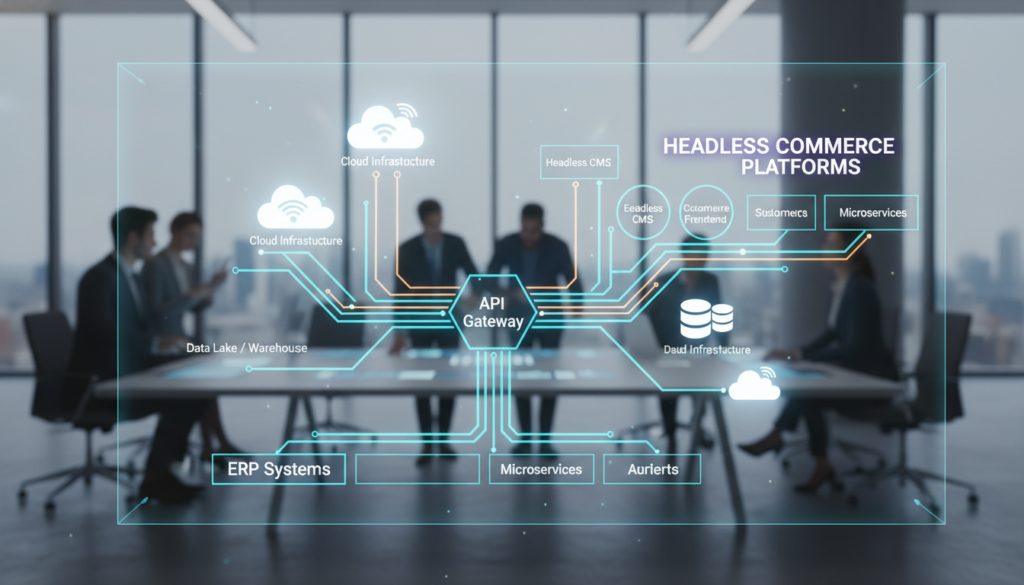
B2B companies need a strong online presence. Combining ERP and headless commerce gives them a unified digital core. This is key for modern omnichannel retail IT, making businesses agile and customer-focused.
Enhancing Customer Experience
Today’s B2B buyers want easy, personalized experiences. A headless front-end offers the fast, sleek interfaces they need. Powered by real-time ERP data, the experience is unmatched.
Customers see accurate inventory and pricing instantly. This cuts down on errors and emails. It builds trust and a self-service environment.
This seamless flow is crucial for omnichannel retail IT. Buyers can start quotes on mobile apps, change them on desktops, and finish orders on tablets. The ERP keeps everything consistent, building loyalty.
Streamlining Operations and Efficiency
Manual data entry is costly and error-prone. Integrating ERP with headless commerce automates this. Orders flow directly into the ERP for fulfillment and updates.
This automation cuts processing time and errors. The order-to-cash cycle speeds up. Your team can focus on customer service and strategy.
The table below shows the benefits of this integration:
| Business Area | With Siloed Systems | With ERP-Headless Integration | Key Improvement |
|---|---|---|---|
| Order Processing | Manual data entry, high error rate, slow turnaround | Automated via B2B e-commerce API, near-zero errors, real-time | Speed & Accuracy |
| Inventory Management | Delayed updates, risk of overselling or stockouts | Real-time sync, accurate visibility across all channels | Reliability |
| Customer Service | Multiple systems to check, delayed response times | Single source of truth, instant access to order & account data | Efficiency |
| Financial Reporting | Manual consolidation, lagging reports | Automated revenue recognition, real-time P&L insights | Timeliness |
Driving Data-Driven Decisions
The integration creates a unified data pool. It combines sales, inventory, customer interactions, and finance data. This gives leaders a complete view of the business.
You can analyze customer behavior and product trends. This clarity is key for smart forecasting and planning.
With this omnichannel retail IT foundation, decisions are data-driven. Teams can spot opportunities and risks quickly. They can tailor marketing and optimize inventory with confidence, driving growth.
Key Components of a Headless Commerce ERP Integration
An ERP system and a headless commerce platform work together through specific parts. These parts make sure the system is flexible, data flows smoothly, and B2B companies can move fast. Their role is crucial.
A strong integration goes beyond just connecting systems. It’s built on two key elements: an API-first approach and a microservices architecture. Together, they make a digital commerce engine that’s strong and can grow.
API-First Approach
An API-first strategy means everything is built around APIs. For B2B e-commerce, this is essential. Good APIs connect the front-end and the ERP backend.
This B2B e-commerce API layer handles important data exchanges in real-time. It’s about things like inventory, customer prices, and order status. When the front-end needs data, it asks the API, which gets it from the ERP.
“In modern commerce, the API is the contract. It defines how systems talk, ensuring reliability and speed for complex B2B transactions.”
The benefits are obvious. Teams can update the front-end without changing the ERP. New sales channels can be added by connecting to the same APIs. This makes your investment future-proof and supports a true decoupled architecture.
Microservices Architecture
Microservices architecture breaks down big commerce apps into smaller, independent services. Each service handles a specific task. For example, shopping cart, product search, checkout, and payment processing.
This design fits well with the decoupled architecture of headless commerce. Each microservice can be worked on, deployed, and scaled separately. If the product search service gets too busy, you can just scale that without affecting others.
Here are some benefits for B2B operations:
- Independent Development: Teams can work on different services at the same time, speeding up progress.
- Resilience: A problem in one service, like the cart, won’t stop the whole buying process.
- Technology Flexibility: Each service can use the best technology for its job.
When combined with an API-first design, microservices create a strong, flexible base. The front-end uses these services through APIs, while each service works with the ERP for backend data. This setup is the technical heart of a modern, flexible B2B commerce platform.
Steps to Successfully Integrate ERP with Headless Commerce
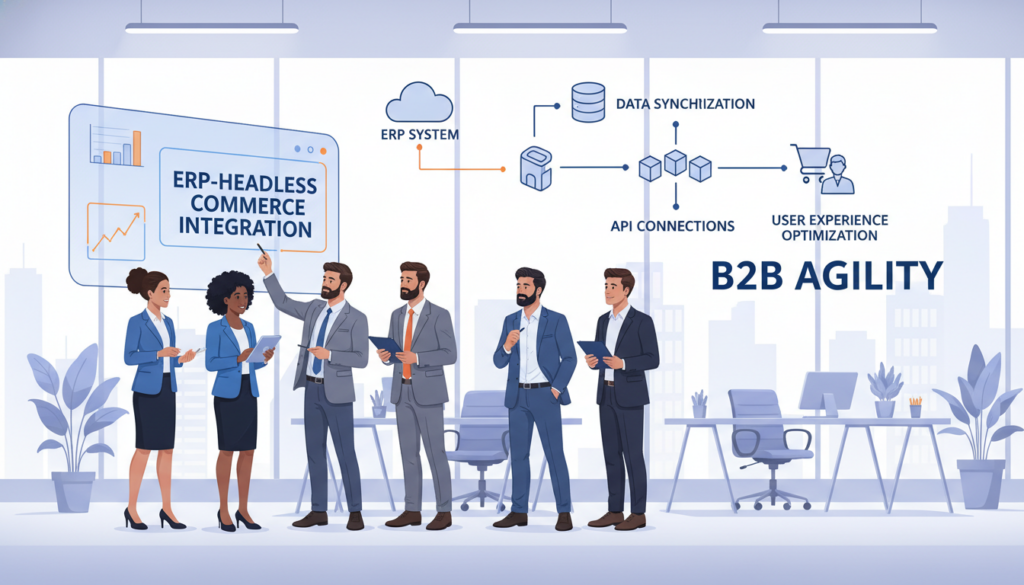
To build agile business systems, companies must follow a structured integration process. This journey connects your operational backbone with a modern commerce front-end. A methodical approach reduces risk and ensures the system supports your long-term goals.
We have learned that skipping foundational steps leads to costly rework. Each phase builds upon the last, creating a stable and scalable headless commerce ERP environment.
Assessing Business Needs
The first step is a deep dive into your organization’s specific requirements. This is not about technology alone. It is about aligning the integration with strategic business outcomes.
Work with stakeholders from sales, finance, IT, and operations. Map out current pain points in order management, inventory visibility, and customer data flow. Define clear goals, such as reducing manual data entry by 30% or enabling real-time pricing updates.
This assessment creates a blueprint. It tells you exactly what the integrated system must achieve. Without this clarity, you risk building a solution that misses the mark.
Choosing the Right ERP Solution
Your ERP is the core of your agile business systems. Selecting the right one is critical for a smooth headless commerce ERP connection. Look beyond basic features to integration readiness.
Key evaluation criteria include:
- API Maturity: The ERP should offer robust, well-documented APIs for bi-directional data flow.
- Cloud-Native Architecture: Cloud-based ERPs offer better scalability and easier updates.
- Industry-Specific Functionality: Ensure it handles your unique business rules and compliance needs.
- Vendor Ecosystem: A strong partner network can provide proven connectors and support.
We recommend creating a scoring matrix to compare solutions objectively. Focus on how each ERP will connect to a headless front-end, not just how it operates in isolation.
Selecting a Headless Commerce Platform
The commerce platform is the customer-facing layer. Its ability to integrate seamlessly with your ERP determines the user experience. Your choice should prioritize flexibility and connectivity.
Look for platforms with strong pre-built connectors to major ERP systems. If a pre-built connector isn’t available, the platform must offer powerful, flexible API tools for custom development.
Ask potential vendors about their experience with B2B integrations. Can their platform handle complex pricing models, bulk orders, and customer-specific catalogs pulled directly from the ERP? The right platform acts as a natural extension of your backend, creating a unified headless commerce ERP stack.
This selection process is foundational. The right technology partnership empowers your team to build and adapt quickly, truly embodying the promise of agile business systems.
Common Challenges in ERP and Headless Commerce Integration
Every integration project faces its own set of challenges. Merging ERP systems with a headless commerce platform is no exception. We see these challenges as opportunities for growth, not roadblocks. Successful B2B companies prepare for these hurdles and plan their way through.
Data Synchronization Issues
Keeping data consistent across a decoupled architecture is key. The ERP holds master data, while the headless front-end needs instant access. This is a major concern.
Choosing between real-time and batched data syncs is a big decision. Real-time updates are great for stock levels but can be taxing. Batched updates are simpler but might sell out-of-stock items.
Managing complex product hierarchies and attributes is another challenge. A product bundle in the ERP might need to be shown as individual SKUs on the commerce site. Without careful mapping, data inconsistencies can harm customer trust.
To ensure a single source of truth, robust middleware and clear data governance rules are essential from the start.
Integration Complexity
The technical side of this integration is complex. Many organizations face legacy ERP systems not built for modern, API-first commerce. These systems are hard to connect to agile headless platforms.
Key areas of complexity include:
- Middleware Requirements: Building or configuring a dedicated integration layer to translate data and processes between systems.
- Testing Intricacies: Validating every customer journey, order scenario, and data flow across the newly connected systems is a massive undertaking.
- Microservices Coordination: In a decoupled architecture, ensuring various microservices (cart, checkout, search) all correctly pull from the integrated ERP data source adds another layer.
This complexity affects timelines, budgets, and resource allocation. A phased approach, starting with a core B2B e-commerce API for critical data, helps manage the scope.
Change Management
Technology is just part of the equation. The human element—change management—is often overlooked. Teams used to old systems must adapt to new workflows in a decoupled architecture.
Sales and customer service staff need training on new admin panels or how orders flow from the website directly into the ERP. The finance team must understand new reporting data sources. Securing buy-in from these departments is crucial.
Resistance to change is natural, but it can be lessened through early involvement, clear communication of benefits, and comprehensive support.
We suggest creating cross-functional teams from IT, sales, operations, and finance during planning. This fosters ownership and smooths the transition, turning potential resistance into advocacy for the new system.
Future Trends in Headless Commerce and ERP
The future of business is bright with headless commerce and ERP. This combo is more than a solution to current problems. It’s a foundation for future tech advancements.
We’re moving towards systems that know what we need before we ask. These agile business systems are built for change.
AI and Automation
Artificial intelligence turns data into useful insights. With ERP data, AI can predict market changes with great accuracy.
Predictive analytics manage inventory without human help. This prevents stockouts and overstock. Dynamic pricing adjusts B2B quotes instantly based on many factors.
AI search understands complex part numbers and customer needs. It offers accurate product suggestions, speeding up sales. RPA handles routine tasks, freeing up staff for more important work.
RPA bots do tasks like invoice reconciliation and order processing. This lets employees focus on strategy, improving productivity.
Omnichannel Strategies
The goal of modern commerce is seamless experiences everywhere. A headless front end and a central ERP make this possible. The same data and logic work across all platforms.
This is what omnichannel retail IT is all about. Customers can start their journey on a smart device, then finish on a web portal or with a sales rep.
The agile business systems behind this ensure a consistent experience. This includes IoT sensors and third-party marketplaces where your products appear seamlessly.
Creating such a unified system is challenging. But it’s the key to staying ahead. Companies that succeed will win in customer loyalty and efficiency.
They will truly showcase the power of omnichannel retail IT. Every interaction will be informed, consistent, and efficient.
Case Studies: Successful ERP and Headless Commerce Integrations
A B2B manufacturer’s journey shows the benefits of a headless commerce ERP strategy. Real-world examples are more valuable than theories. We’ll look at one example and share lessons for businesses considering this path.
Example of a Leading B2B Company
A global industrial equipment maker faced a big challenge. Its old e-commerce site couldn’t meet different regional needs. Its SAP ERP inventory wasn’t in sync with the online store, causing errors and upsetting distributors.
The company aimed to solve these problems. It wanted a single view of inventory worldwide and to set prices and payment terms for each market. They chose a headless commerce platform linked to SAP through a strong B2B e-commerce API.
The team used a step-by-step, microservices approach. First, they made product and inventory data from SAP available through APIs. Then, they built a new frontend using JavaScript. This frontend used the APIs to show up-to-date stock and prices.
The results were clear and positive. Errors in order processing fell by over 40% thanks to real-time checks. Launching new country-specific sites went from months to weeks. This speed gave them a big advantage in quick markets.
Lessons Learned from Integration Challenges
These cases offer key insights for a successful integration. The path is not always smooth, but planning helps.
Embrace a Phased Rollout: Avoid the “big bang” launch. The company started with one product and one region. This allowed them to test, get feedback, and fix issues before going global.
Invest in API Governance from Day One: As more B2B e-commerce API connections are made, managing them gets harder. Setting API standards early on helps avoid a mess later. This is crucial for stability.
Prioritize Change Management: The technical side is just half the battle. Teams need training on the new system. Clear communication about changes helps everyone adapt smoothly.
Choose Partners, Not Just Vendors: Pick an ERP and headless platform provider with experience in integration. Their support teams should know how to connect these systems. A good partner offers more than just software.
These lessons show that technology is just a tool. People and processes are what really matter. A well-done headless commerce ERP integration sets the stage for B2B agility.
Final Thoughts on Headless Commerce ERP Integration
Our journey shifts from theory to a key strategy. Merging an ERP system with a headless commerce platform is more than a tech task. It’s a big leap towards modern B2B agility.
The benefits of this merge are clear when we look at its main perks.
Recap of Key Advantages
Businesses see huge gains in efficiency. Tasks like order management and inventory updates become smoother. The customer experience gets a big boost, with tailored paths.
Having one source of truth for data leads to smarter choices. This is thanks to a modern, decoupled setup.
Knowing these benefits, we must take action.
Encouraging Adoption for B2B Agility
In today’s fast-paced market, being agile is crucial. B2B companies need to quickly meet customer needs and explore new sales paths. A strong headless commerce ERP integration is a key investment.
It’s the foundation for excelling in omnichannel retail IT. This move prepares your business for the digital economy. It’s time to build your agile base.